Here are the lyrics and audio for "Take Time When It Comes," an original bluegrass hay baling song by Lannie Dietle. The song tells the true story of the songwriter's first paying job: driving a tractor at age six for twenty five cents an hour. It then follows his haymaking memories into the teenage years, capturing the hard work of stacking bales, and the work ethic forged on the farm. The song blends rural Pennsylvania heritage with a nostalgic reminder to seize good weather — and good moments — before time slips away. Enjoy the free lyrics, personal notes, and streaming audio below.
Well, my first pay'n job
Was a drive'n a tractor.
Be'in cheap labor
Might-a been a factor.
In nineteen and sixty,
I was six years old.
I made a quarter an hour
And did as I was told.
My legs were really short,
But that meant nuthin',
I could reach the hand brakes
And smack the kill button.
When the sun is shining,
Ya gotta make that hay
Take time when it comes,
Lest time steal away.
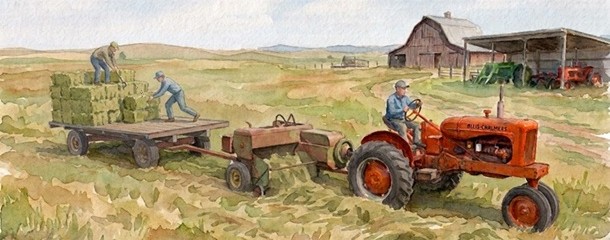
I was towing a baler
That was towin' a wagon.
I had to stay sharp,
There was no time for slack'n.
I steered to keep the baler
Lined on the windrow,
Back when I was bal'n hay
Such a long time ago.
When the sun is shining,
Ya gotta make that hay
Take time when it comes,
Lest time steal away.
At the end of the row
I pulled the throttle down,
Cranked the steer'n wheel,
And turned the rig around.
Victor and his boys, they
Stacked bales on the wagon.
By the end of the day,
Their tails were really draggin.
When the sun is shining,
Ya gotta make that hay
Take time when it comes,
Lest time steal away.
So many memories
From the Marburger farm.
A work'n in the fields,
And hangin' round the barn.
Stackin' them bales,
It weren't no vacation.
It was hard, hard work, and
made me thirst for education.
When the sun is shining,
Ya gotta make that hay
Take time when it comes,
Lest time steal away.
Oh, take time when it comes,
lest time steal away.
Thoughts on this bluegrass hay baling song
The bluegrass song "Take Time When It Comes" tells the true story of my first paying job: Driving a tractor to bale hay for our next-door neighbor Victor Marburger when I was six years old, for 25 cents an hour. The song also peers into the teenage years, when I did the much harder work of stacking bales on the wagon, and then unloading and stacking them in the ridiculously hot barn. Baling hay was a routine part of farm life back then. It was the sort of hard work that helped a teenage boy develop a good work ethic while earning some spending money. At the same time, baling hay helped a boy to understand that he didn't want to be performing that sort of hard manual labor all his life!
Childhood rural work memories
The story of tractor driving as my first job is also included in my 2024 book "In the Land of Used to Be," along with many other rural work memories from my youth. I wrote the book to provide a glimpse of what life was like for rural children growing up in the 1953 to 1971
timeframe. It's chock full of childhood memories of country life in western Pennsylvania.
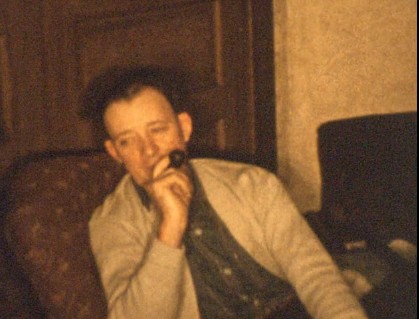
This is is a 1957 or 1958 photo of Victor Marburger, the Mercer County, Pennsylvania neighbor who paid me 25 cents an hour to drive his 1944 model WC Allis Chalmers tractor to bale hay when I was six years old. I was pulling a hay baler that was towing a hay wagon. My primary task was to keep the pickup mechanism of the baler lined up on the windrows of hay.
Other folk & bluegrass songs about Appalachia
Now that you've given my boyhood hay baling song a try, here are some other songs that were also shaped by my Appalachian heritage:
The song is available to stream and download for personal use or radio air play at no cost. For commercial use, such as performing or recording covers of the song, contact me to discuss licensing terms.