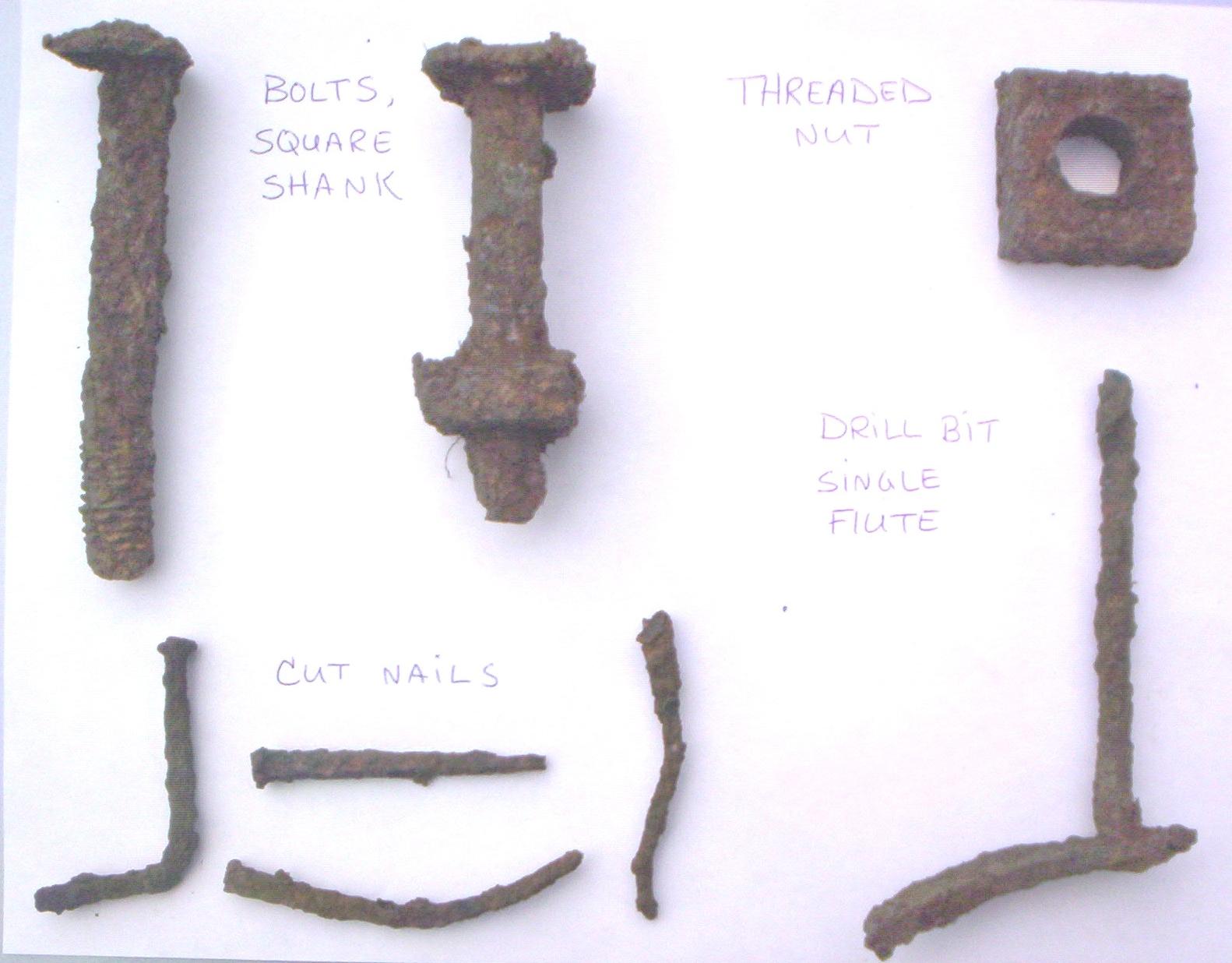
The hardware that is shown above was found at the site of four puzzling rock stacks that are located nect to a canyon-like gully near Route 160 north of Wellersburg, Somerset County, PA. The single flute, fast twist drill is unusual in the manner that it is attached to another metal piece. This is not the well known two flute twist drill that S.A. Morse patented in 1863 (US Patent 38,119). It is very rusty, but Mike believes that it is the older style of drill called a "gimlet bit". Such drills were hand held, and were used for boring holes in wood for the blunt-ended wood screws that were made prior to 1846. He has determined that the handle that is attached to the bit was made for manual use because what remains fits the hand well (see photos below). He reports that upon close inspection, the flute width appears to become smaller near the end it of the bit, which is a characteristic of a gimlet bit. Click here to see an article on this subject on a third party web site. The drill bit was found right near the stack comprising the propped-up large rock (see sketch of site at bottom of this page). The photos above were taken before the drill bit was cleaned by sand blasting.

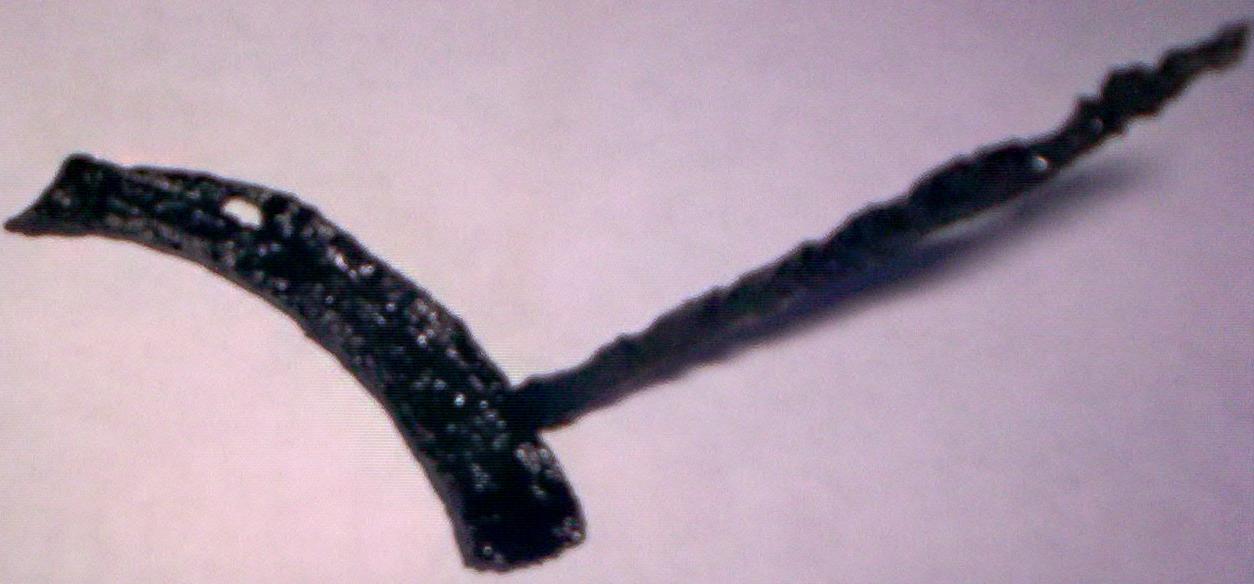
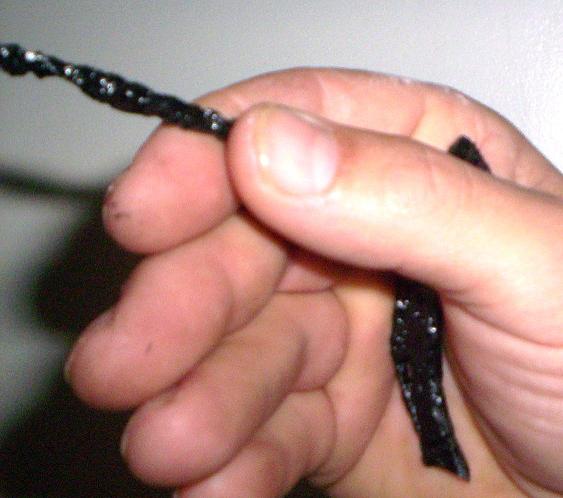
The next photo below shows the bit after it was cleaned up with sand blasting. The photo shows that the handle was made from a small horseshoe; note the nail hole for nailing the original shoe onto a horse's hoof. The handle also exhibits the typical groove that is found on a horseshoe. The fact the handle is a horseshoe indicates that at least the handle was blacksmith made and attached to the bit. The drill was welded or presed into another nail hole in the horseshoe. The photo after that shows how the tool was held for boring out holes. It doesn't surprise me that the bolts and the hand drill would be blacksmith-made, because I have seen various tools from Southampton township that were gunsmith/blacksmith-made, including a large tap and die, a small tap and die, a tap wrench and even spring-loaded pliers.
The nails that were found are cut (not wrought) square nails. Mike reports that the nails appear to have a head that protrudes over each of the four sides of the nail (as opposed to a variety of cut nail that has no head, and a variety that only has a head that overhangs on one side of the nail).
The bolts have half inch square shanks, and they were found a few inches in the ground, which tells Mike they have been there a long time. The square shank on the bolts may have been to help to prevent the bolt from turning in a drilled hole. The diameter of the round threaded portion of the screw was about the same size as the square portion, as measured flat-to-flat. Mike believes that the bolts may have been blacksmith-made, rather than commercial products.
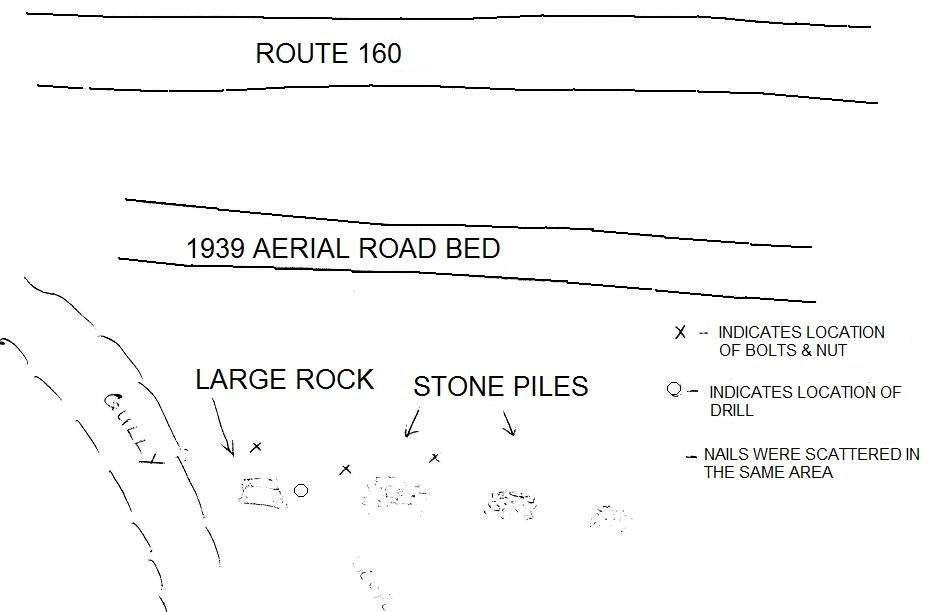
The final image below is a sketch that Mike made of the site to show the loctation of the rock piles relative to the gully and the road beds, and to show where some of the hardware artifacts were found.
Return to the Rock Stacks page
Return to the Korns family genealogy home page

