Introduction
The Moll rifle photos on this page were provided by Stephen Miller of BV Colonial Crafts. The photos show features of a smooth rifle of the Bethlehem school of gunsmithing. The gun was made by one of the gunsmiths named John Moll who worked in Allentown, which is within the present-day bounds of Lehigh County, Pennsylvania. The focus of this website is rifles made in the Pennsylvania counties of Somerset and Bedford. I am posting pictures of this Moll rifle because the interesting figure carved into the stock just forward of the trigger guard is very similar to the figure represented by a silver inlay that is located just forward of the trigger guard of a handsome flintlock rifle that was made by Benjamin Franklin Troutman of Somerset County, Pennsylvania.
The Moll rifle featured on this page is Rifle No. 66 in Kindig's 1960 book "Thoughts on the Kentucky Rifle in its Golden Age". The rifle is pictured on pages 180 and 183 of that book, and is described as being signed "John Moll" on the upper flat of the octagonal barrel. According to page 183 of the book, Rifle No. 66 has an overall length of 59.25 inches, and has a 46 caliber smoothbore barrel that is 44.75 inches long. For biographical information on the Allentown gunsmiths named John Moll, see pages 305 to 308 of Kauffman's 1960 book "The Pennsylvania-Kentucky Rifle".
Page 180 of the Kindig book reports that the carved figure on Rifle No. 66 is nearly identical to the carved figure on a John Rupp rifle that is included in the book as Rifle No. 62. The carved figure that is featured on page 175 of the Kindig book may be from Rifle No. 62, but I'm not sure. Rifle No. 62 of the Kindig book is included as Plate 44 on page 51 of Kauffman's 1960 book.
L. Dietle

Comparison photos of the figure-based decorations
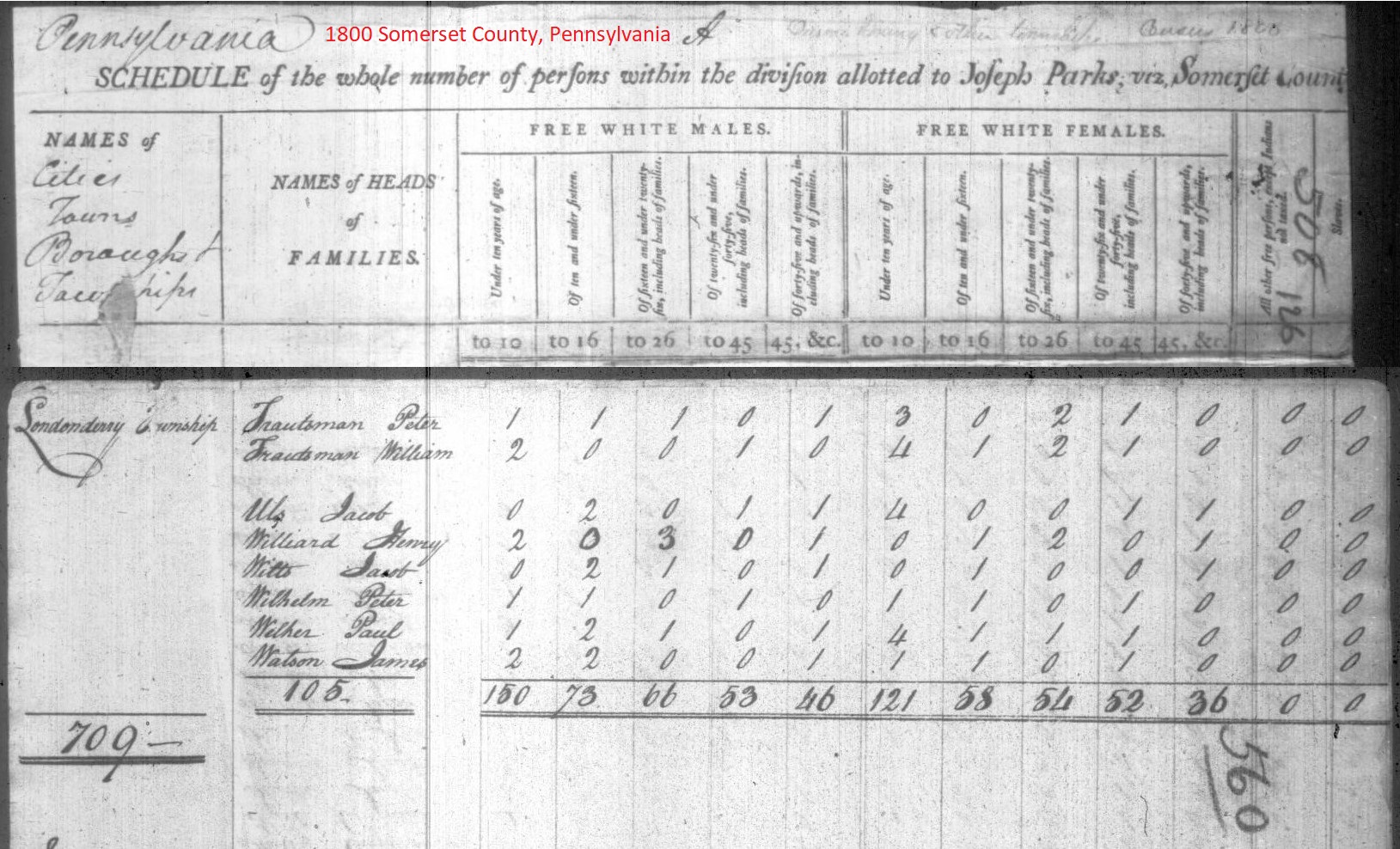
According to the Benjamin Troutman biographical information page, Benjamin Troutman's father Peter was living in Greenwich Township of Berks County in 1780 and was living in Londonderry Township of Bedford County in 1789. This suggests that Benjamin, who was born in 1780, was also living in Londonderry Township of Bedford County by 1789. The fact that Benjamin Troutman's father came from Greenwich Township of Berks County, which isn't very far from Allentown, may help to explain how Benjamin Troutman came to include the figure on a rifle he made. At least three other individuals who lived near Benjamin Troutman in what is now Somerset County, Pennsylvania also migrated from places that were fairly close to Allentown:
Other photos of the Moll rifle
The following picture provides an oblique view the right-hand side of the buttstock, including a view of the four-piece engraved un-pierced patch box. The peripheral shape of the patch box finial on this rifle is quite similar to that of Rifle No. 62 (Rupp) in the Kindig book.
The following photograph provides an oblique view of the toe plate.
The following image provides an oblique view of the top of the buttplate.
The following picture provides a nearly straight-on view of the patchbox lid.
The following picture provides a nearly straight-on view of the patchbox finial.
The following image shows the location of the carved figure on the underside of the stock of the Moll rifle, and also provides an oblique view of the wrist, trigger guard, and lock panel areas of the rifle.
The following picture shows the engraved thumbpiece on the top of the wrist. The engraved initials appear to be "JR".
The following picture provides an oblique view of the muzzle and nosecap. Although the nosecap does not cover the end grain of the stock, an inner portion of the nose cap conforms to the shape of the barrel. The inner and outer portions of the nosecap appear to be made from the same piece of sheet brass. The brass is thicker at the ramrod channel, which suggests the presence of an overlapping seam (hat tip to Eric Kettenburg).
The next photo provides an overall view of the right-hand side of the buttstock.
The next picture provides an enlarged view of the buttstock carving that is located between the cheekpiece and the buttplate.
The next photo provides an enlarged view of the cheekpiece inlays.
The following photo shows the brass lock bolt plate. A small portion of the lock bolt plate is broken away in the vicinity of the upper/rear lock bolt. The photo also provides a clear side view of the single trigger.
A dated Moll Rifle with similar details
According to Kauffman's book, John Moll I died in 1794. That means that the 1815-dated Rifle No. 65 was not made by John Moll I. (hat tip to Eric Kettenburg). The simularities between Rifle No. 65 and Rifle No. 66 may suggest that Rifle No. 65 and Rifle No. 66 were made by the same gunsmith. However, I am definitely not an expert on Moll rifles, and I do not know if John Moll II or John Moll III copied features of rifles made by John Moll I.

In the following image, the incised carving of a figure on the Moll rifle (left) is compared to the engraved inlay of a figure on the Troutman rifle (right). Both figures are located on the underside of the stock, just forward of the trigger guard. For a photo of a similar inlay on another Benjamin Troutman rifle, see page 56 of Whisker's 2017 book "Gunsmiths of Somerset County, Pennsylvania" or page 138 of the Whiskers' 1991 book "Gunsmiths of Bedford, Somerset and Fulton Counties".
Theoretically, Benjamin Troutman may have based his inlay design on the carving of a Bethlehem school rifle that was brought westward to what is now Somerset County by Peter Troutman, William Troutman, Sr., Michael Korn, Sr., or Jacob Reiber. Alternately, Benjamin Troutman may have known other people who came from the vicinity of Allentown, and/or owned a Bethlehem school rifle with a figure-based carving.


Rifle No. 65 in Kindig's book is a swivel breech rifle that is inscribed, "John Moll, October 25, 1815". The rifle has many features that are identical to, or very similar to, the features of Rifle No. 66 (hat tip to Eric Kettenburg):