A Photo Tour of the Turkey Foot Road of Maryland & Pennsylvania: Part 2
Return to PART ONE of the Turkey Foot Road tour
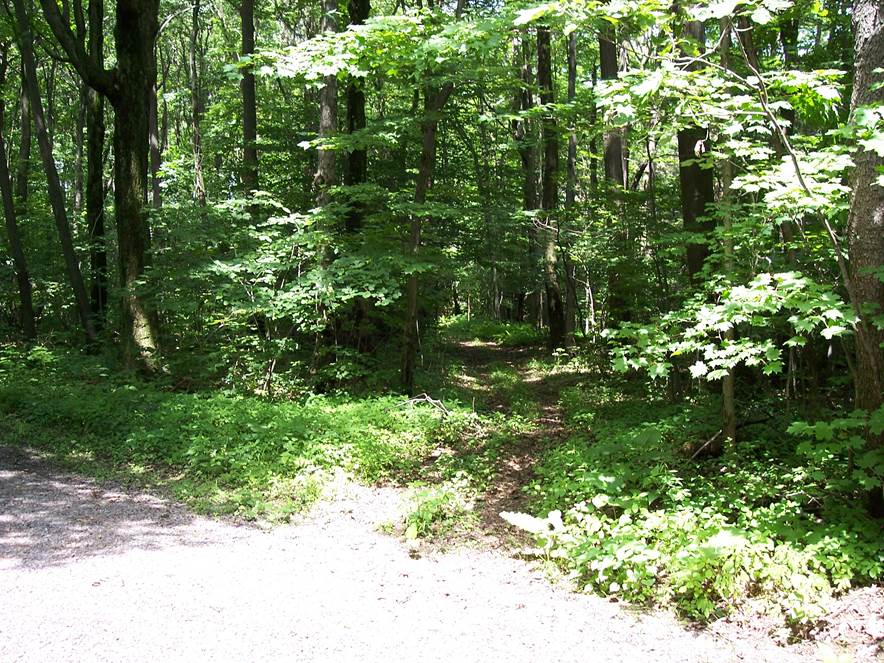
Near Pocahontas, the 1785 route survives as a trail
At
approximately 39.724415,
-78.940319 the 1785 route crossed the Greenville Road. From there, the old
road was typically located no farther than about 600 to 1,000 yards west of the
Greenville road. It joined the present route of Greenville Road east of the
Greenville Lutheran Church, right where Red Dog Road terminates. Along the way,
the 1785 route crosses Hemlock Lane at 39.731028,
-78.952056, and crosses Murray Road at 39.736333,
-78.960972. The photo above shows where the Turkey Foot Road crosses Hemlock
Lane. This trail matches the route shown on a 1785 survey and a 1939 aerial photo. Except for the size
of the trees, this shows what the Turkey Foot Road looked like in the old days on level ground.
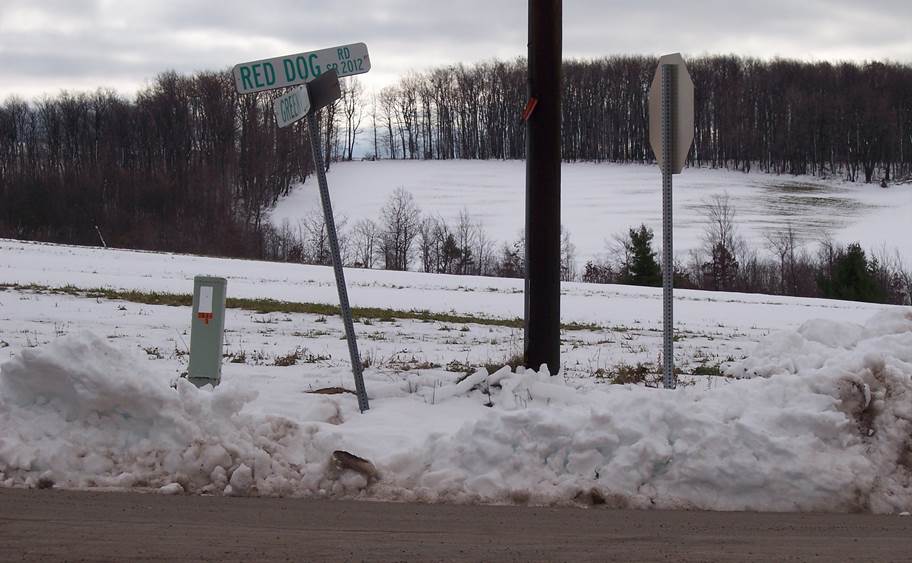
Where the old route joined the Greenville Road
The photo above was taken looking southwest from Greenville
Road. The 1794 road ran between the intersection sign
[39.748357,
-78.970655], and the corner of the field behind the sign. The Greenville
Road follows the old route west from this location to 39.748671,
-78.998512.
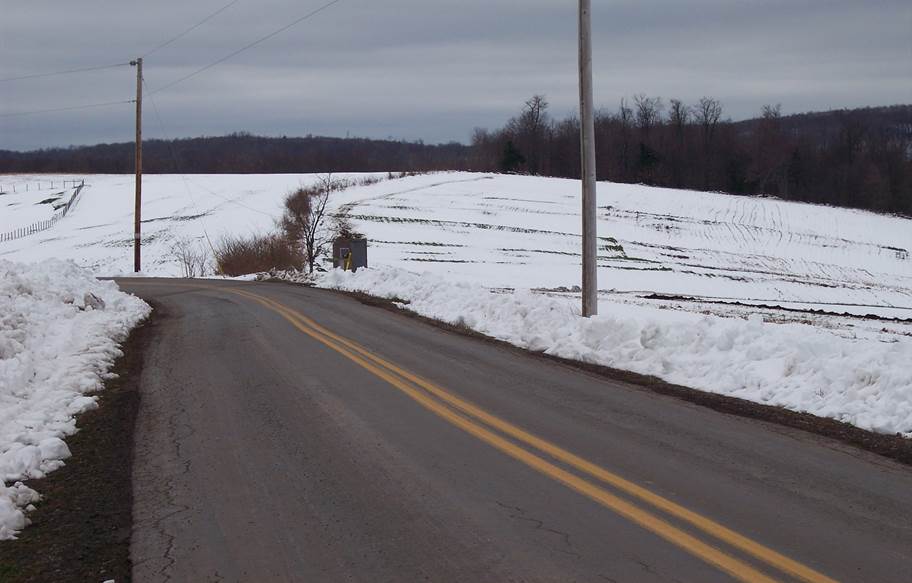
Where the
1819 route departs from the Greenville Road
The photo above was taken along the Greenville Road, looking west to 39.748671,
-78.998512, where the modern road turnns sharply southwest toward the
Greenville gap. In 1819, the Turkey Foot Road followed the fencerow shown here
to 39.748019,
-79.003903, then passed through 39.749111,
-79.014455 as it headed toward the Alllegheny Mountain. The fencerow is
visible on present day satellite imagery. The 1700s route was farther north, crossing
Haldeman's "Camp Misery" tract, parting ways with the 1800s route east
of the Greenville Lutheran Church [39.751279,
-78.990827]. Both routes crossed the Allegheny Mountain at the same point.
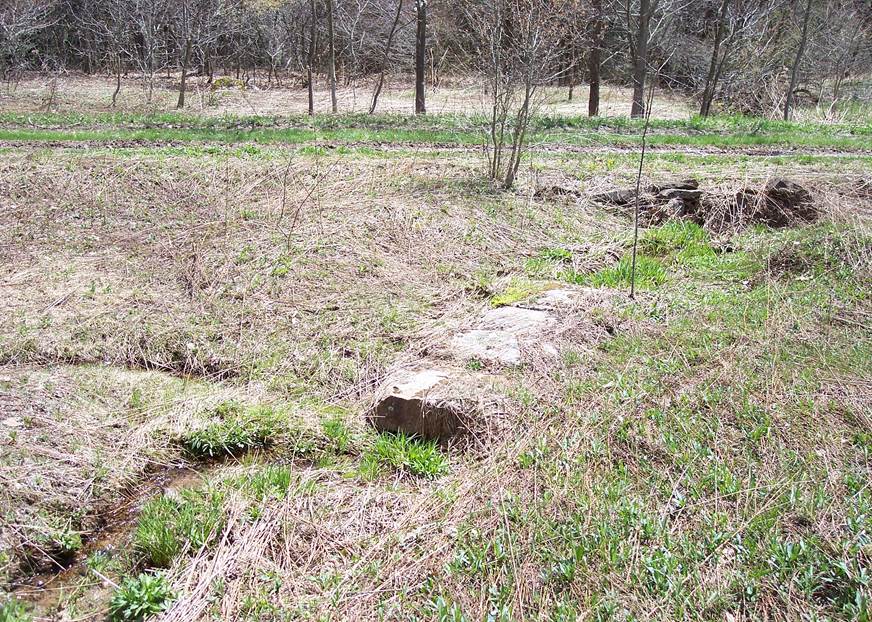
A stone culvert, on the east side of the Allegheny Mountain
The photo above shows a culvert
from the Turkey Foot Road. It is located a few hundred yards east of the crest
of the Allegheny Mountain, at 39.741096,
-79.037578. It aligns with a variation of the Turkey Foot Road that enters
the field from the east.

This
isolated farm is located back a long lane, one mile north of where the
Greenville road passes through the Greenville gap. It used to be right on the
main road: The Turkey Foot Road.
Straight down the west side of the Allegheny Mountain
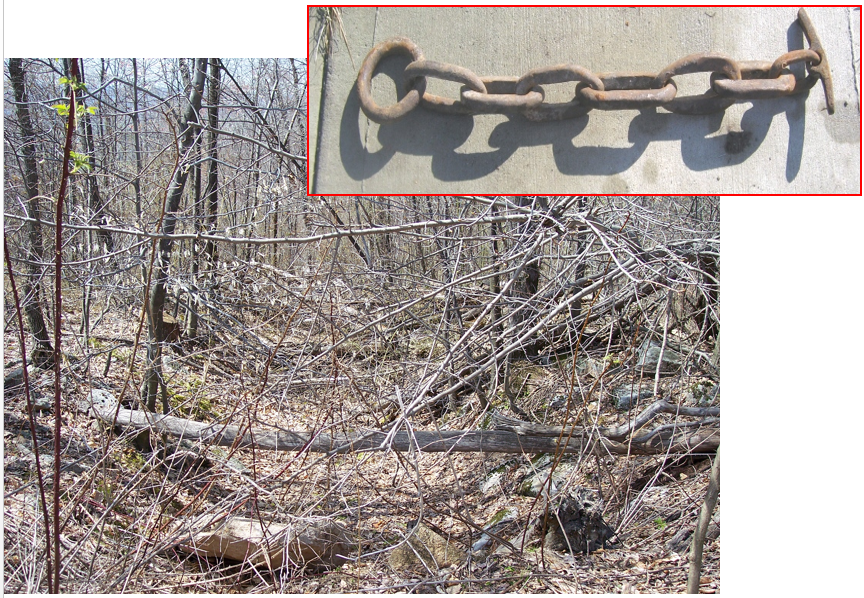
The photo above shows the
deeply sunken road bed going straight down the west side of the Allegheny Mountain from 39.742317,
-79.044017, and enters a field at 39.7475,
-79.050850. The road had had to go straight down the mountainside, to avoid
rolling wagons over. Despite this precaution, there was a fatality on this
section of road as a result of a runaway wagon. The wagon driver who was killed
was the son of Douglas Baker, who surveyed Salisbury.
The rocks in
the foreground were knocked there by a bulldozer. Apart from these rocks, the
roadbed is completely rock free. The bulldozer was used to make a private road
that crosses the old roadbed.
The gizmo at
the upper right is a "rough brake" It was used to lock a wagon wheel
when going down mountainsides. If you didn't have a rough brake, you tied a
treetop to your wagon to provide extra drag.
The road ran past Clement Engle's mill
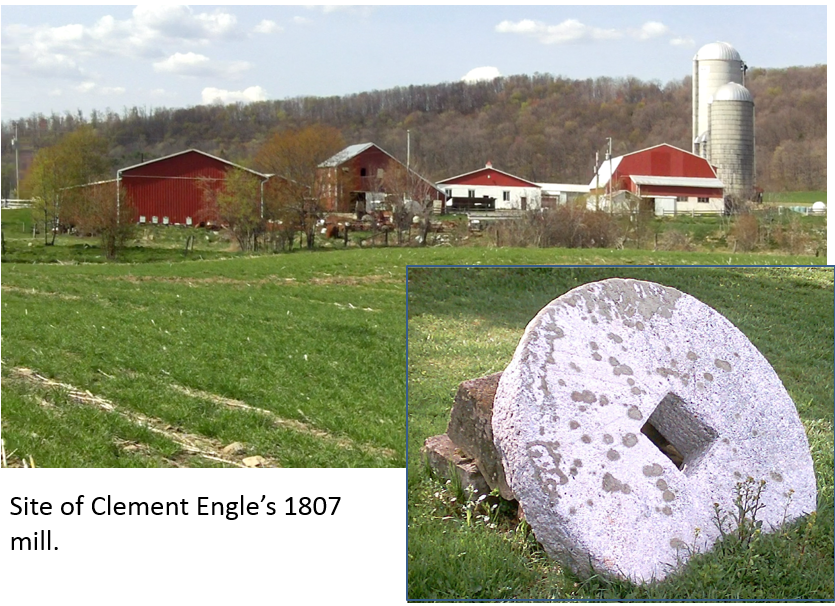
West of the
Allegheny Mountain, the road passed Clement Engle's 1807
mill [39.752882,
-79.061453], which was destroyed by fire in 1927. The images above show the site of the mill, and a millstone that is said to be from the mill.
Lowry brick house
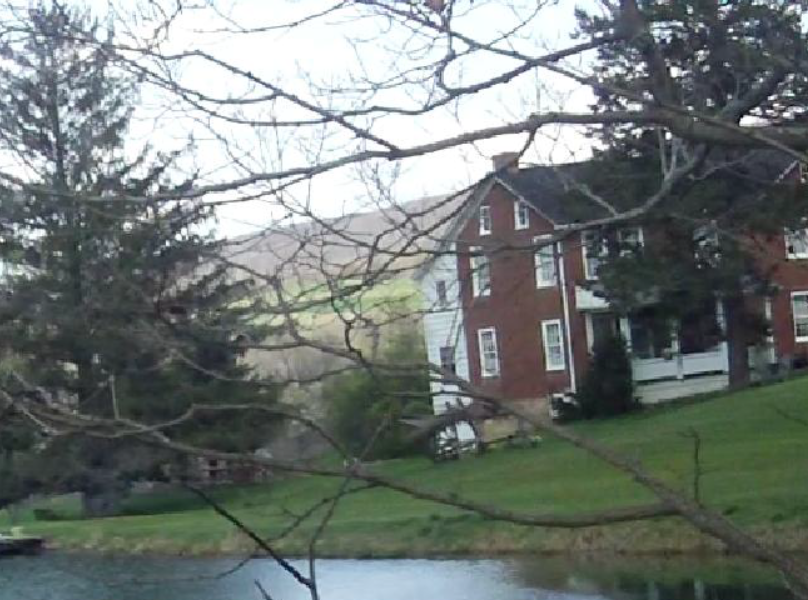
After passing Engle's mill, the Turkey Foot Road ran past the circa 1845 Lowry brick
house [39.749924,
-79.067466], which is shown in the photo above.
Ord Street, in Salisbury, is the Turkey Foot Road
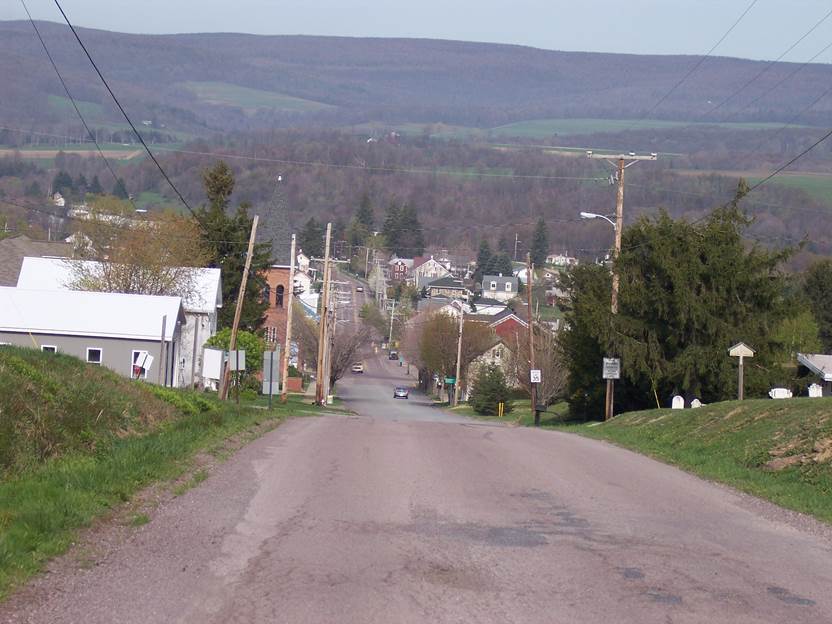
This photo was taken looking
west into Salisbury, along the Turkey Foot Road. Negro Mountain is in the
background. This area was settled very early. The Turkey Foot Road was routed
through here in 1779 to obtain forage from the settlement. One of the settlers
was my ancestor Peter Livengood, who came in 1775.
An 1809 log
church was located at the old cemetery on the right [39.752332,
-79.077313].
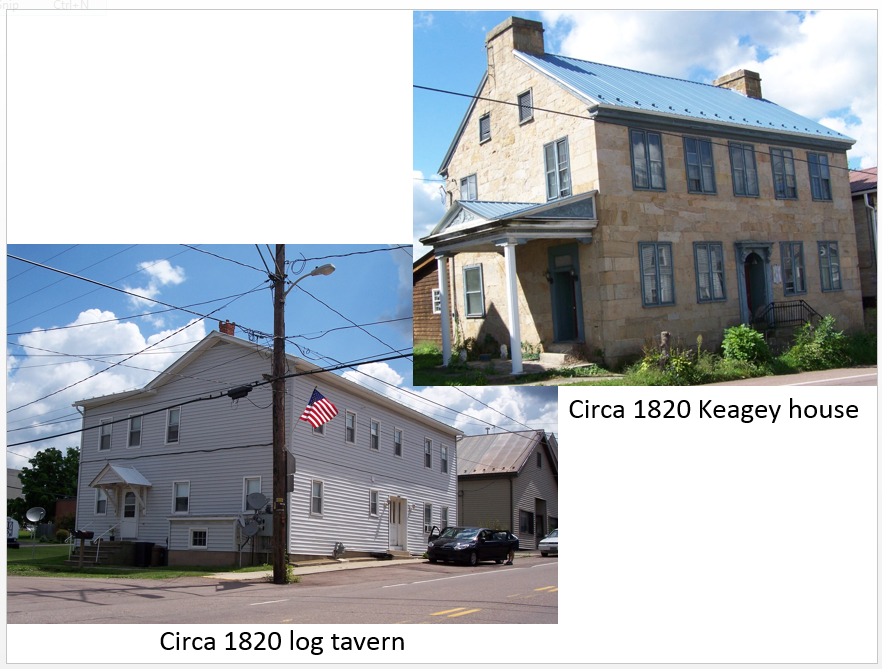
Salisbury, Pennsylvania
The pictures above are from Salisbury, Pennsylvania. According to tradition, the log portion of the house at the lower left [39.753205,
-79.08261] dates from 1820, and was an inn along the Turkey Foot
Road. One of the sons of my ancestor John Markley founded the town in 1794, and
another retired in this house.
The stone house in the photo
at the upper right [39.752933,
-79.082532] was built along the road around 1820 by John Keagey. He stole a
wagon-load of merchandise, and was caught selling the goods at his store. He
died shortly after being caught. People assumed it was suicide by poison.
Because of this, they refused to bury him in the church graveyard.
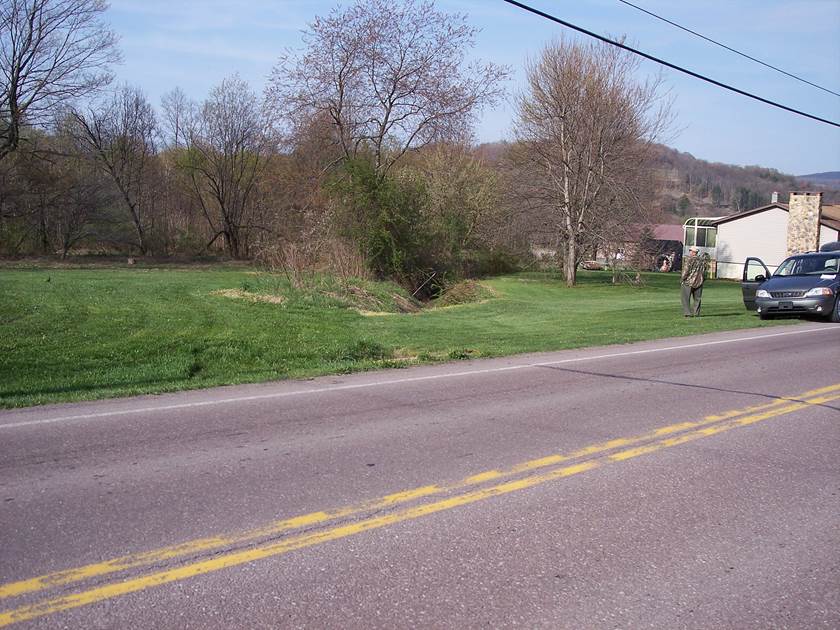
The route to the fording site in Salisbury looks like a ditch
The ditch in the photo above is actually the eroded bed of the Turkey Foot Road. This [39.754059,
-79.089152] is where it turned to the Casselman River fording site. This
sunken road still shows up as an abandoned street on present day town plats,
and is visible on satellite images.
That's Harry
Ringler, Sr. in the picture. He taught me the traditional route variations in
Somerset County. Harry seems to know everybody. He was able to take me on
private property to study landscape scars. Harry's son is a cartographer for
Somerset County. He provided old maps that helped to pinpoint the Somerset
County route.
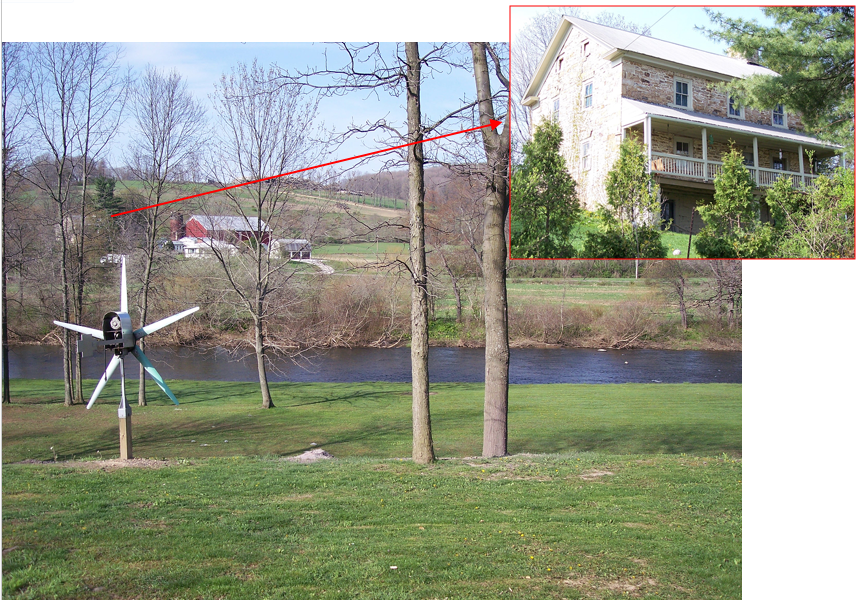
The Casselman River fording site at Salisbury
The photo above shows where the Turkey Foot Road forded the Casselman River. It was also the site
of an Indian Village. Harry Ringler found a bunch of arrowheads here when he
was growing up. This is the "Long Field" described in history books.
When the first settlers arrived, it was an abandoned Indian field. The fording
sites were located between 39.752609,
-79.093355 and 39.752271,
-79.093044, and are visible on 1939 aerial photos. The probable reason the
ford was in use so long was so that livestock could drink while crossing.
The
1809 Beachey house [39.751015,
-79.094927] is just barely visible on the left. It is also shown in the
upper corner. The 1700s Turkey Foot Road ran along the left (southern) flank of
the hill in the background, following a route similar to present day Springs
Road (Route 669) between approximately 39.748675,
-79.098194 and 39.742315,
-79.122205. An earlier packhorse path passed on the right (northern) flank
of the hill. William Tissue lived along that path, and entertained packhorse
drivers. His home was located to the right of the barn, just past the end of
the field. After Tissue's wife was murdered by a hired hand, he moved down the
road to Turkeyfoot.
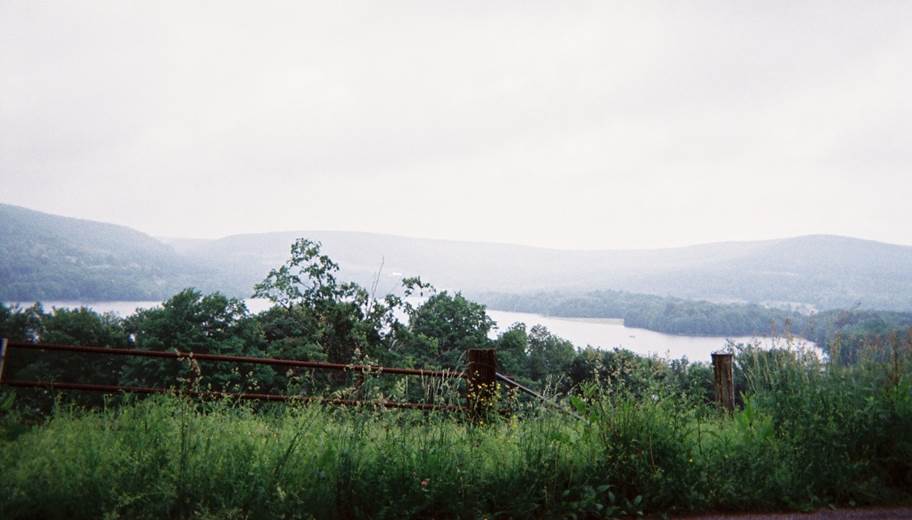
A view from the road at Winding Ridge, along High Point Lake
The above photo of
High Point Lake [39.779222,
-79.217617] was taken from High Point Road, looking north. High Point Road
is part of the earliest provable route. The lake was a swamp in the 1700s.
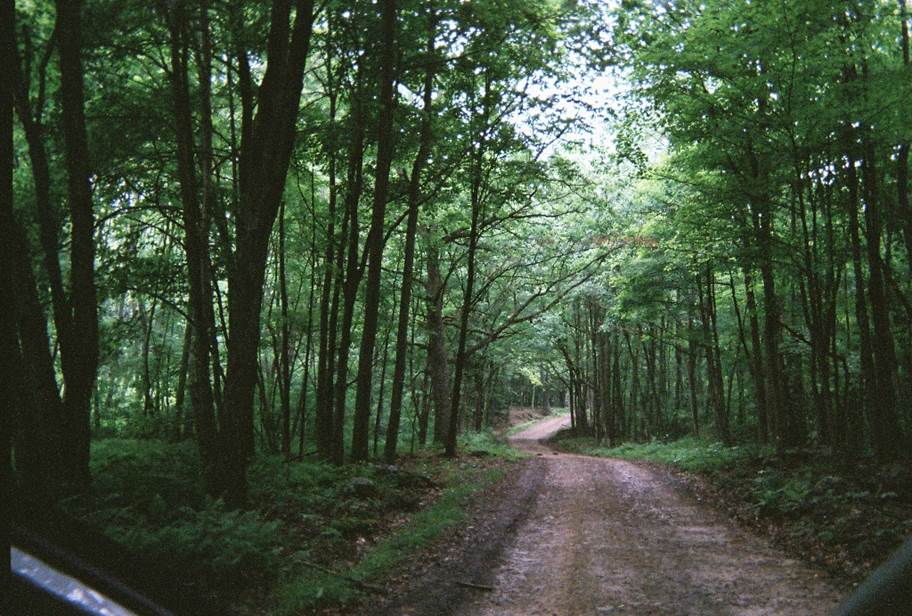
Green Road is still very primitive today
The photo above shows Green Road, looking east. This is a relatively good section of what was once known as
the Turkey Foot Road.
This is a much
more direct route, compared to the Mount Davis Road. Such directness was
important in the days of animal powered transportation.
Don't try this road without a horse, or four wheel drive.
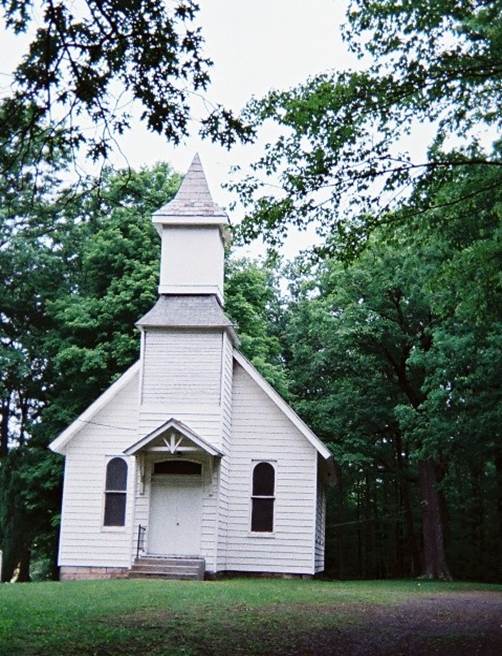
The 1879 Silbaugh Church on Fort Hill Road
The photo above shows the
1879 Silbaugh church building, which is located at 39.786498,
-79.291447. It is located along a surviving part of the Turkey Foot Road,
but it is called the Fort Hill Road today. The congregation was founded in the
1820s.
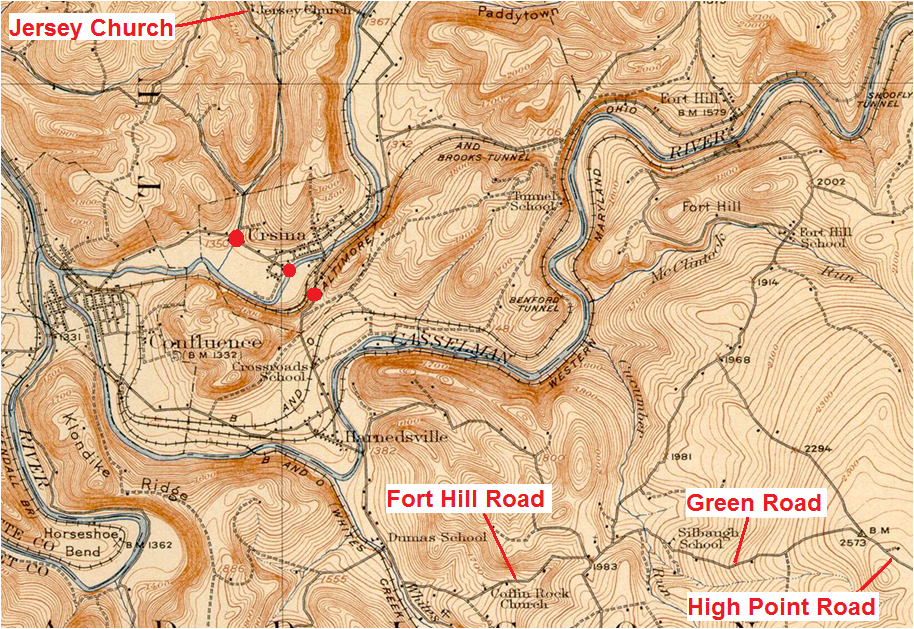
The 1700s route survives near Harnedsville and through Ursina
The name
"Turkeyfoot" comes from the joining of three waterways at Confluence. You
can see them at the left on the topographic map included above. George Washington's papers contain the earliest
known use of the name "Turkeyfoot". It is on the map from his 1754
journal. The surrounding area, was, and still is, known as Turkeyfoot. The
Turkeyfoot Road got its name because it passed
through the Turkeyfoot region. It didn't actually go to the site of Confluence.
High
Point Road, Green Road, and Fort Hill Road are shown at the lower right. From
about 39.780294,
-79.239433 to 39.781931,
-79.317094, High Point Road, Green Road, and Fort Hill Road are the current alignment of the Turkey Foot Road.
Surveys
from 1786 and 1796 show the route through Ursina. That's what the red dots represent. Chestnut
Street and Groff Road are surviving sections of the Turkey Foot Road. After
Ursina, the road ran past the Jersey church, which is shown at the top of this
image.
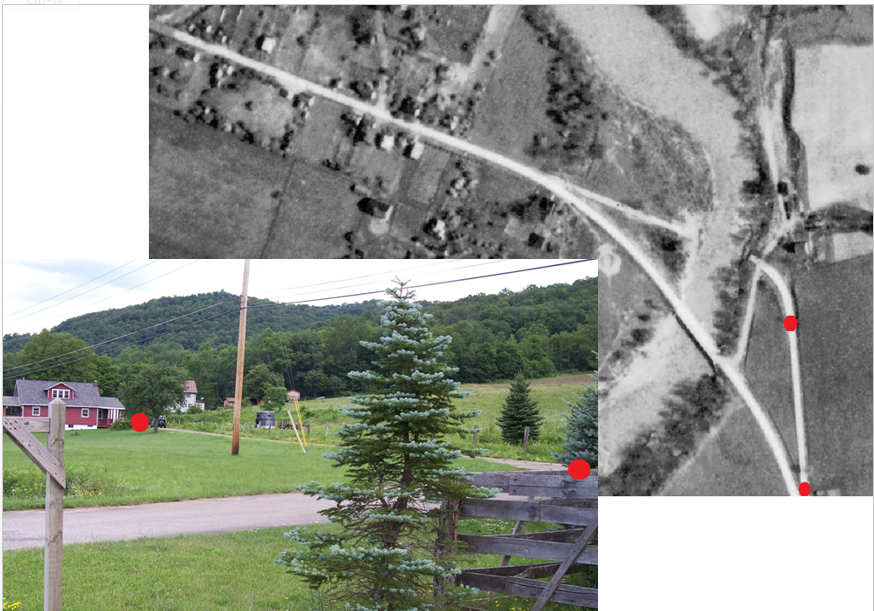
The covered bridge approach at Harnedsville
In the picture above, the street
between the red dots went to a covered bridge at Harnedsville
that crossed the Casselman River at 39.795278,
-79.322737. The bridge was buillt at or near Green's fording site in
1815.
The first bridge cost 779 dollars. Part of the money was raised by local citizens. The bridge washed away in 1832, and was rebuilt for 900 dollars.
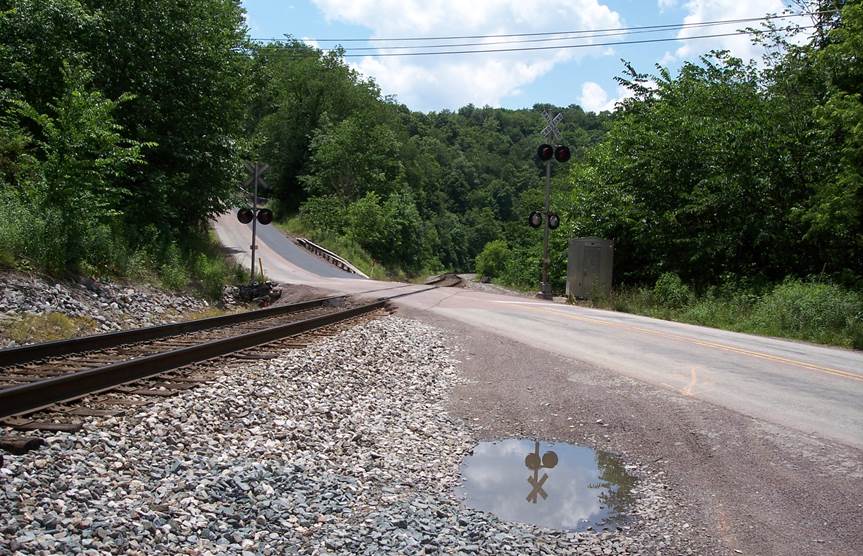
Site where a train hit a buggy in 1889
The photo above shows the
railroad crossing that is located between Harnedsville and Ursina, at 39.804382,
-79.329140. Jeremiah Liston's buggy was hit by a train here in 1889. In the
original jury trial, Liston was awarded 950 dollars. He had to go to the
Pennsylvania Supreme Court to get his money.
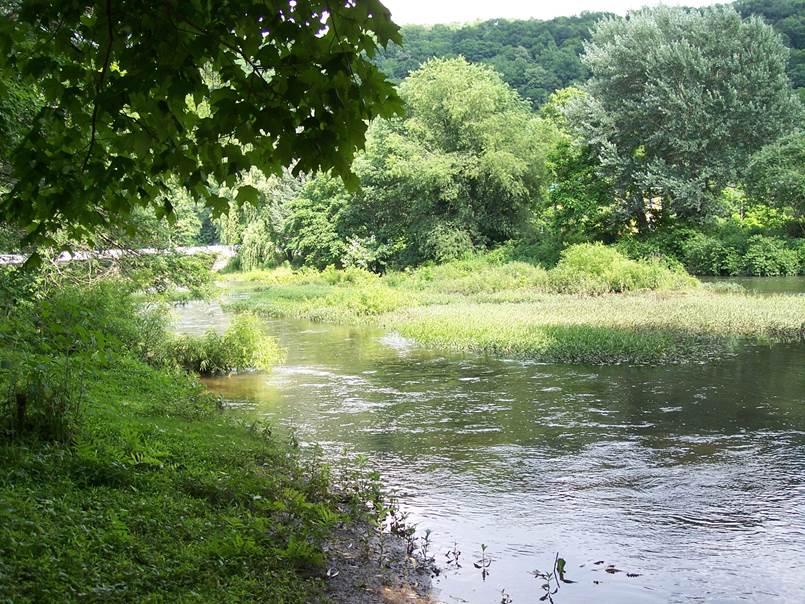
The traditional fording site at Ursina
The photo above was taken along Laurel
Hill Creek, at the traditional fording site in Ursina
[39.815436,
-79.330302]. Although the tradition is probably correct, the 1790s
route is a few hundred feet west. Logs from the old settlers' fort were found
near here when building a house.
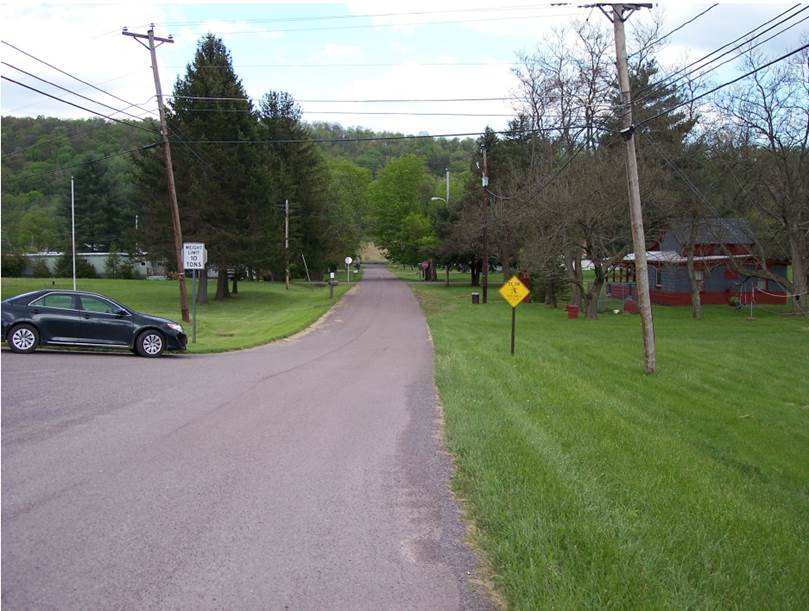
Chestnut Street in Ursina
The photo above, which was taken in 2013, shows Chestnut Street in Ursina, Pennsylvania. Chestnut Street is the modern
alignment of the old Turkey Foot Road that is depicted on the 1786 survey of
Benjamin Pursell. The photo was taken from 39.815739,
-79.335207 West of these coordinates, Groff Road is the old route.
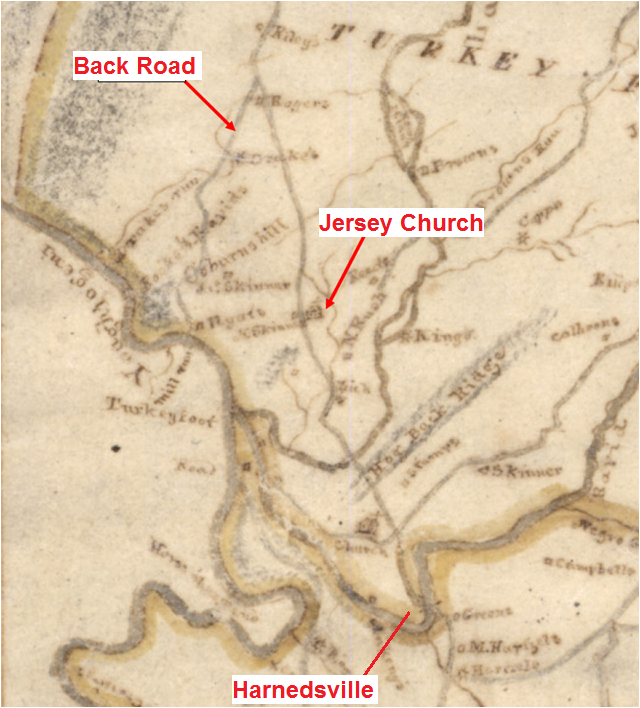
The 1818 Melish-Whiteside map of Somerset County
The map excerpt above is from the 1818
manuscript map of Somerset County. It is a good resource for understanding the
route, and identifying early residents.
This
fragment shows the route north from Harnedsville, and identifies the location
of the Jersey Church. North of Ursina, tradition informs us that the route
followed Jersey Hollow [39.830533,
-79.333598], and this 1818 map shows it passing the Jersey Baptist Church [39.841019,
-79.337536].
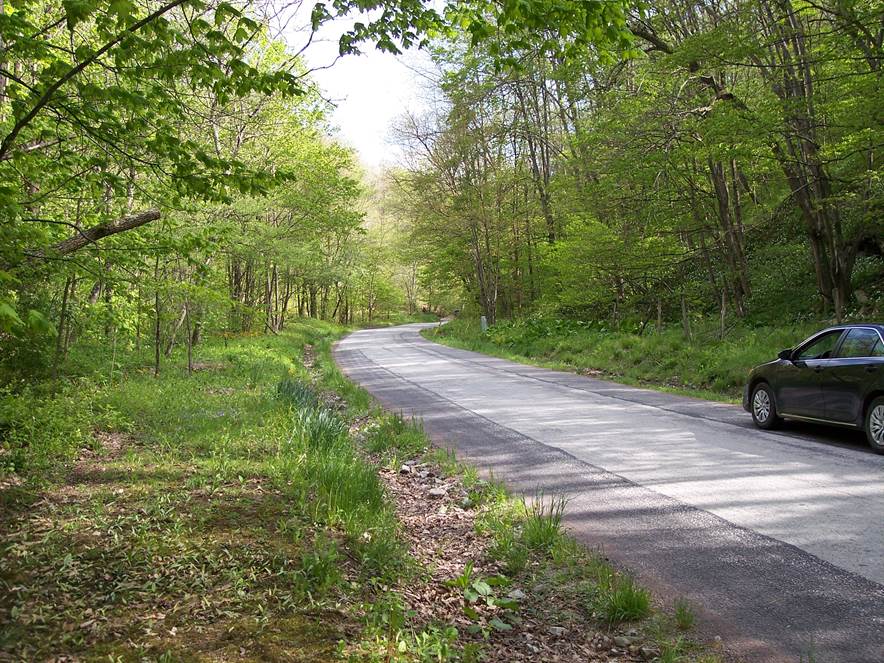
Jersey Hollow, north of Ursina
The photo above shows the present-day
road through Jersey Hollow, north of Ursina. Due to the constricted nature of much of
the hollow, it seems like the original route had to be at, or very near, the modern route.
According to
tradition, the Jersey Settlers passed through here around 1770.
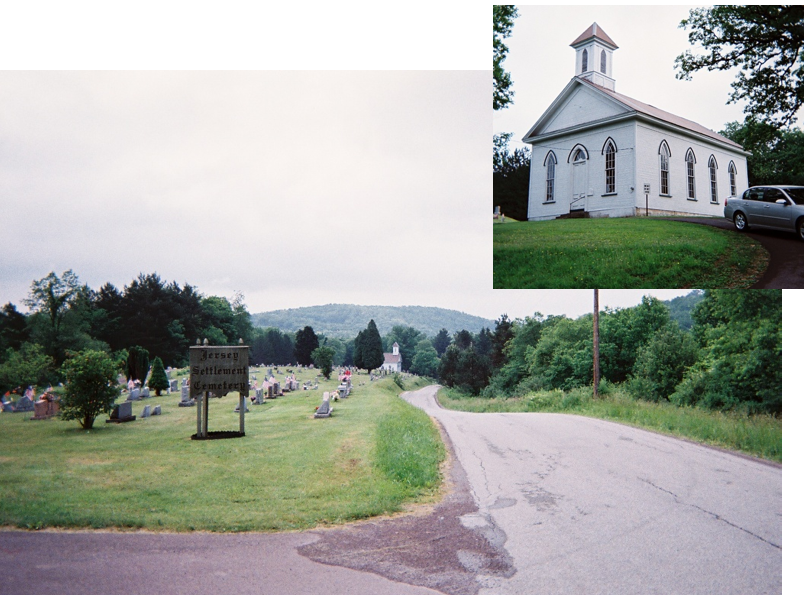
The oldest Baptist Congregation west of the Allegheny Mountain
The Jersey
Church is the oldest Baptist congregation west of the Allegheny Mountain. The
left-hand picture included above was taken from the north end of the new cemetery, looking
south. The 1877 church building is visible in both pictures.
The
congregation was founded on August 14, 1775. This proves that the Jersey
settlers arrived before the military road was cut in 1779.
North
of the church, between approximately 39.849683,
-79.341931 and 39.876649,
-79.354747, Jersey Hollow Road follows the route that existed in the 1785
to 1814 timeframe.
CONTINUE THIS PHOTO TOUR -- IN FAYETTE
COUNTY

Return to the main Turkey Foot Road page