Introduction
L. Dietle
Photos
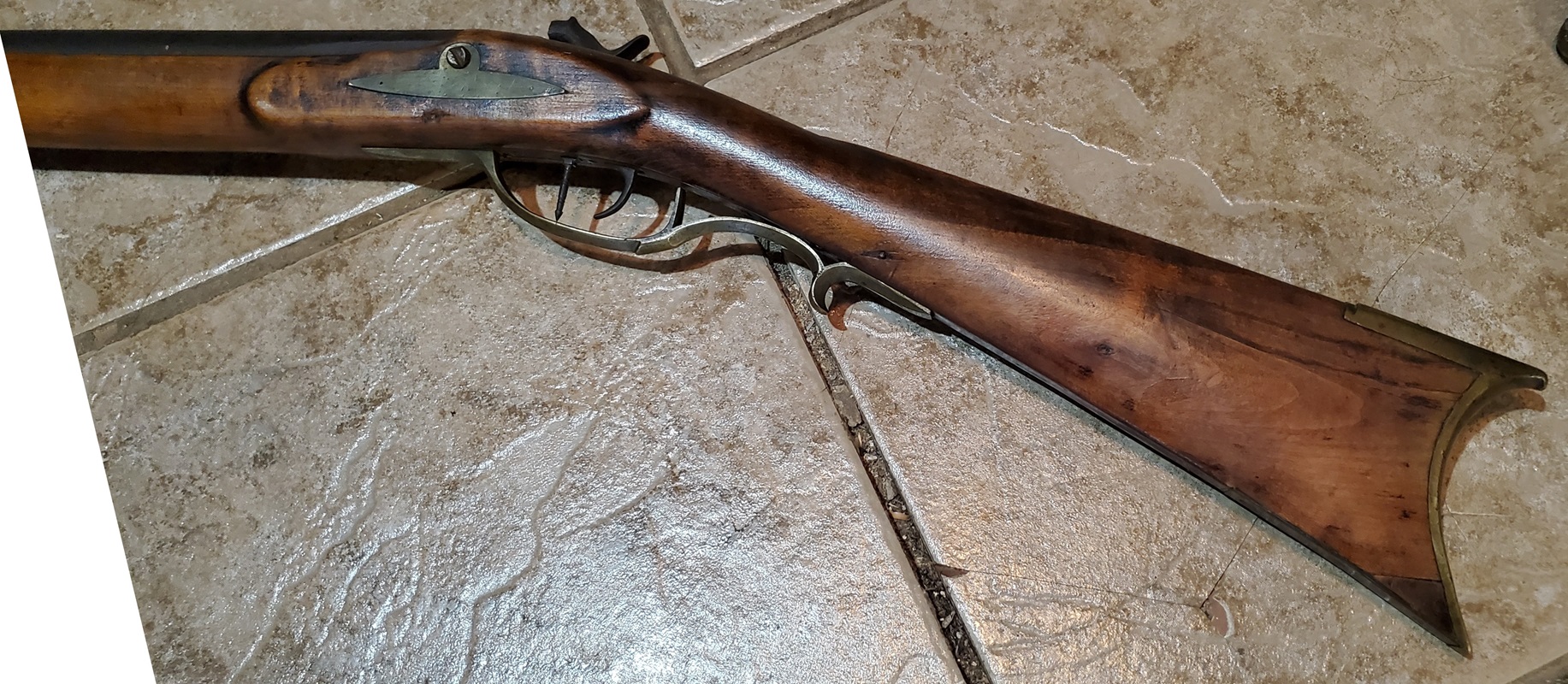
The next image provides a slightly oblique view the rear portion of the shotgun, from the crescent-shaped buttplate to the ramrod entry pipe. Despite being protected by a long toe plate, the toe of the stock has been broken and repaired. The profile of the comb of the buttstock is ever so slightly convex, and the profile of the belly is ever so slightly concave. The raised panel for the lock has a modestly pointed tail, as does the raised panel for the lock bolt plate (see farther below).
The next photograph features the commercially manufactured percussion lock, as well as the percussion drum. You can also see that the sides of the breech of the musket barrel are flattened, and the head of the screw that retains the hammer is worn. The recessed nose of the hammer appears to be very well-aligned with the nipple.
The following photo shows the "R Ashmore & son" stamping on the lock plate.
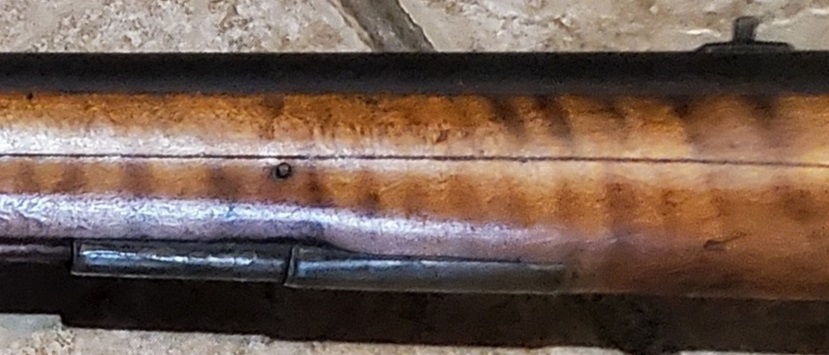
The next photograph shows the right-hand side of the forearm. The incised line may have been added to help to locate the metal cross-pins that retain the barrel to the gun stock.
The next photo is an enlargement that was made from the preceding photo to show the front ramrod thimble, the front sight, the nose cap, and the flared end of the ramrod.
The next photo shows the muzzle of the thin-walled smooth bore musket barrel, along with the Kentucky rifle-style nose cap. The fit between the un-grooved nose cap and the barrel is excellent.
The next picture provides a view of the entire left-hand side of the shotgun.
The next picture provides a view of the left-hand rear portion of the gun, from the crescent-shaped buttplate to the raised panel for the lock bolt plate. It also provides a good side view of the trigger guard and the double trigger arrangement.
The next photo is an enlargement of a portion of the preceding photo, to better-show the lock bolt plate, triggers, and cast brass trigger guard of this antique full-stock cap lock shotgun. The set trigger is curved. The straight hair trigger appears to be lathe-turned. It seems a little strange to see a set trigger arrangement on a shotgun that is based on an old musket barrel. The transverse metal pins that retain the trigger guard to the stock are visible in the photo. I guess you could say that the lock bolt plate is shaped like the supposed profile of a flying saucer. The lock is retained to the stock with a single screw.
The next two photos show the stampings on the breech of the musket barrel. The stampings include the initials "US", the date "1831" and the inspector's initials "JM". I have been told that according to information in an old Dixie Gun Works catalog, the inspector stamp "JM" was used by sub-inspector Justin Murphy at various armories in the 1813 to 1833 timeframe.
Two tang screws are visible in the second photo.
The next picture shows the left-hand side of the forearm.
The next photo is an enlargement from the preceding picture, to show the ramrod entry pipe. The transverse metal pin that retains the entry pipe to the stock is also visible.
The next photo is another enlargement, to show the forestock and nose cap.
Explore the gunsmith index for additional muzzleloader pictures
The following photos, which were provided by Sean Busko, show an unsigned muzzle loading shotgun that is based on a musket barrel. The stock profile is that of a 19th century Bedford County, Pennsylvania long rifle. This old gun was owned by Sean's great-grandfather Harvey Isett who lived in Marklesburg, Pennsylvania. (Marklesburg is 8.5 miles north-northeast of Bedford County on Route 26.) Harvey Isett also owned a rifle that was made by Bedford County gunsmith J. N. Mathesiee. Sean reports that his family doesn't know the circumstances of his great-grandfather obtaining the two guns. Sean also reports that the overall length of the gun is 56.5 inches, and the barrel is 42 inches long and has a bore that is close to a 16 gauge. Based on that description, and the barrel stamps shown farther below, I think the barrel is a .69 caliber United States flintlock musket barrel that has been converted to percussion.


The first photo below provides a view of the entire right-hand side of the attractively-proportioned percussion shotgun. Although the buttstock seems (to me) to clearly be made in the style of the Bedford County school of gunsmithing, that isn't proof that the gun was actually made in Bedford County. For example, many Somerset County long rifles have similar buttstock profiles. On the other hand, the buttstocks of Huntingdon County long guns are typically narrower, top to bottom. The barrel on this gun incorporates front and rear sights. The rear sight is located to the rear of the ramrod entry pipe.