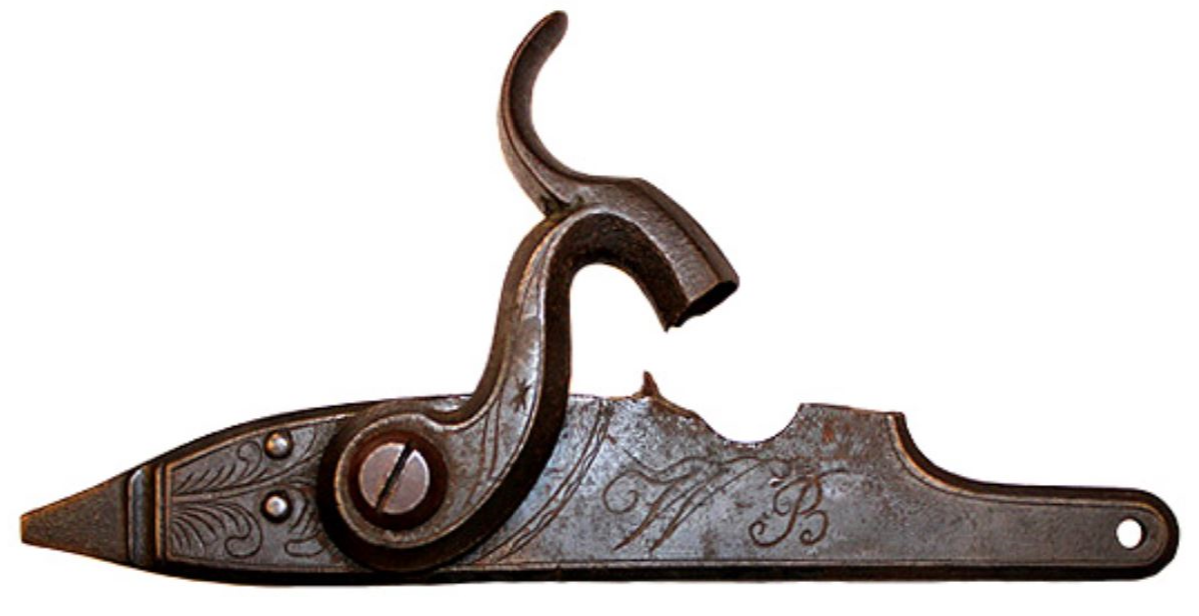
The photo below shows an engraved percussion rat tail lock made by William Border (1800-1881) that has several desirable characteristics. William Border was an important gunsmith in Bedford County, Pennsylvania. He often signed his gun locks with his full last name, but this one is inscribed with his initials "WB" in cursive. At least one other lock exists that is signed "WB". Click here for biographical information on William Border.
The aesthetically pleasing hammer on this lock has the slender S-shape and high spur that are distinguishing characteristics of percussion hammers of the Bedford School of gunsmithing. The forward-facing surface of the spur is a deep concave curve. The curve of the spur forms an intersection with (instead of a tangency with) the convex curved surface that forms the top of the faceted hammer nose.

The rat tail of the narrow lock plate is another desirable aesthetic feature of Bedford County gun locks. The rat tail on this lock is located below the center of the lock plate. This allows the tail of the lock plate to be better aligned with the downwardly curving trailing end of a stock panel. (The tails of some Bedford County locks are more centered on the lock plate, which causes them to be noticeably misaligned with the trailing end of the stock panel.)
In addition to the classic rat tail, the lock plate of this original hand-made Bedford County lock has the vestigial remains of a vertically oriented fence/flash guard behind the drum recess. Such fences were apparently intended to divert some of the cap flash and debris away from the shooter's eyes, and away from the portion of the gun stock that is located rearward of the drum. Such fences are present on some, but not all, Bedford County percussion gun locks. They seem like an excellent idea, given the severe wood damage that is present rearward of the drum on a great many antique black powder muzzle loading percussion rifles. (Cap flash tends to make wood turn punky.) I suspect that the fence on this gun lock may have been larger when new, and and may have become reduced in size by the accumulated corrosive action of many cap detonations.
Much of the periphery of the thicker portion of the lock plate is beveled. The thinner tail portion of the lock plate is unbeveled. A vertically oriented slash-like feature separates the thicker and thinner portions of the lock plate.
A friend uses investment casting to produce high fidelity replicas of the components of this and other gun locks. Some knowledge of gunsmithing is required to assemble the castings and create a finished lock, such as drilling, tapping, heat treating springs, etc. Click here for additional information on investment cast percussion lock parts and flint lock parts, or click on the advertisement below.
L. Dietle

Browse the gunsmith index to access additional information on Bedford and Somerset County muzzleloaders.
Visit the home page for other regional history topics.