Introduction
L. Dietle
Photos
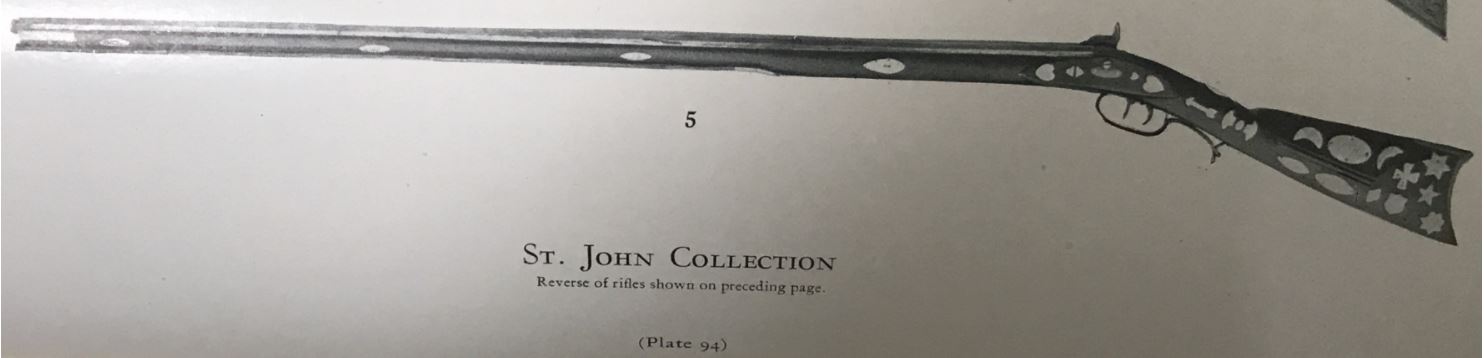
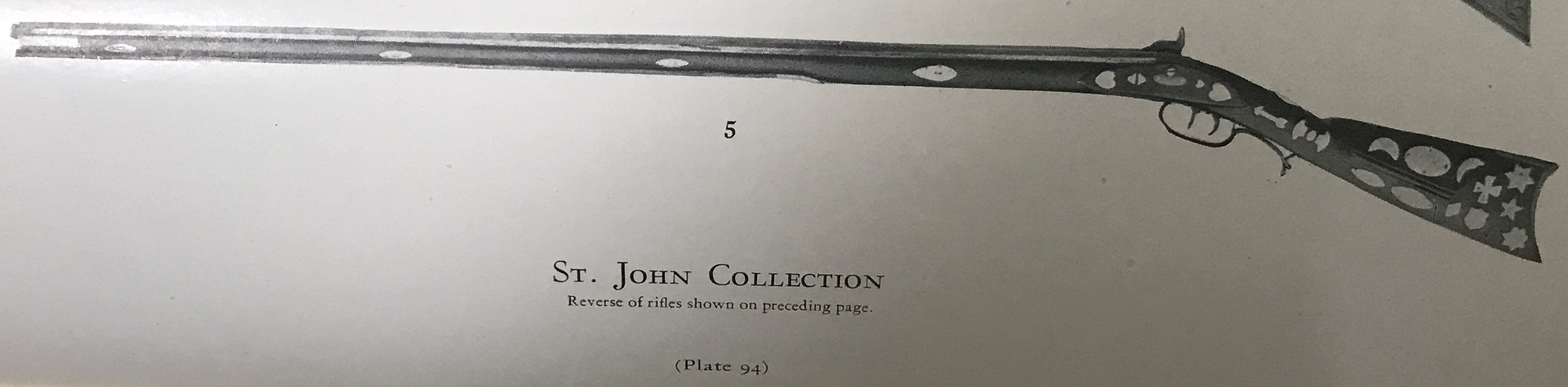
The next photo shows the left-hand side of the rifle, with its jumble of gaudy decorative inlays that include hearts, triangles, an arrow, moons, an ellipse, a Maltese cross, a five-pointed star, a seven-pointed star, a star of David, a shield, a diamond, and two lanceolate inlays. The barrel key escutcheons are also lanceolate in shape. The book indicates there are a total of 30 silver inlays and six brass inlays.
Although my understanding of the evolution of rifle decoration is limited, I do not think that Peter White's lifetime extended into the era of such gaudy decoration (He died in 1834). The rifles by Peter White that I am aware of incorporate tasteful relief carving and sometimes incorporate tasteful and elegant engraved decorative inlays.
The 1924 book reports that this rifle was owned by someone associated with Buffalo Bill. Perhaps we can blame this helter-skelter collection of inlays on that owner, as a modification that occurred after the gun was restocked, and long after it left Peter White's hands in its original flintlock configuration.
The next two photos of the Peter White muzzle loading rifle are larger, higher resolution images, and are included because they may reveal more detail.
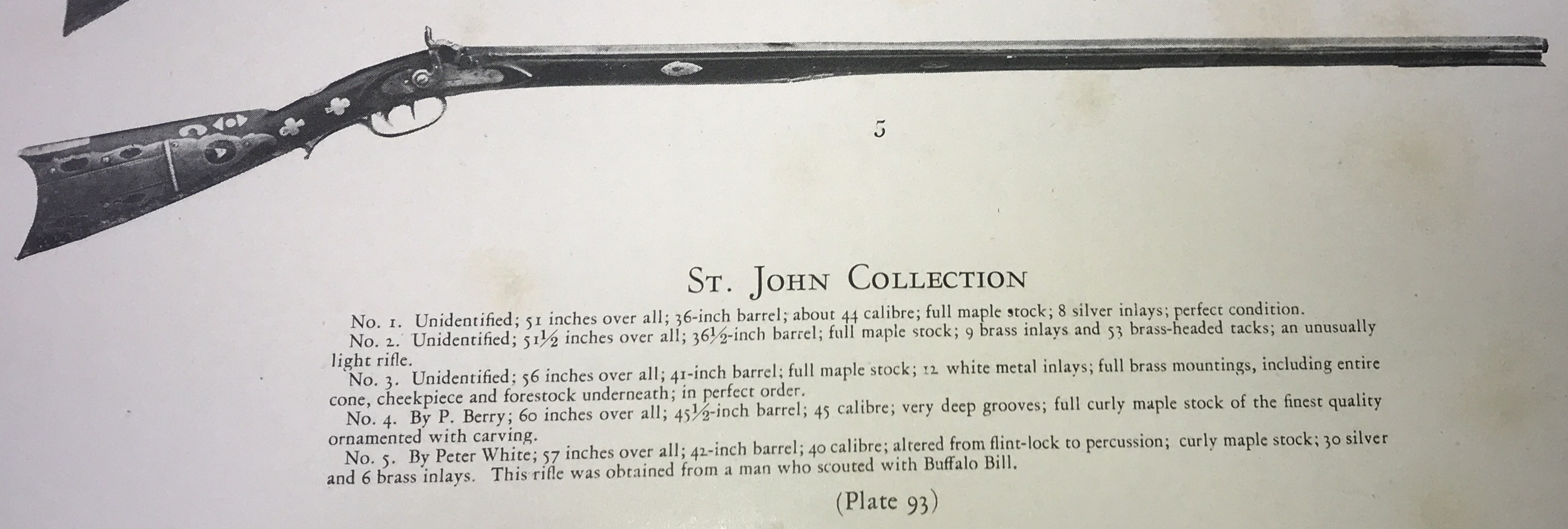
These photos, which are from the 1924 edition of Dillon's book "The Kentucky Rifle", show a full stock percussion conversion muzzleloader that was reportedly made by a gunsmith named Peter White. I have heard of an early gunsmith named Peter White who worked in Annapolis, Maryland. I am more familiar with an individual named Peter White who probably got his start in Emmitsburg, Maryland and worked as one of the early gun makers of Bedford County, Pennsylvania before moving to Fayette County.


The first photo shows the right-hand side of the rifle, which has a patch box with five piercings and the Q-shaped finial that is found on so many Bedford County rifles. I am no expert on antique muzzle loading rifles, but to me, the stock shape does not seem consistent with Peter White's known work and (to my limited understanding) does not seem consistent with the flintlock period. I suspect that the rifle was originally built by the Peter White who worked in Bedford County, and was restocked long afterwards by a western gunsmith. The caption in the book indicates that the rifle is 57 inches long and has a 40-caliber barrel that is 42 inches long. A rifle attributed to Peter White that has the same patch box finial is shown on page 2 of the July, 1970 issue of the "Muzzle Blasts" magazine.

 Go to the Gunsmith Index to access pictures of Bedford and Somerset county long rifles, and to access biographies of the gunsmiths who made them.
