Moses Wright is one of only a handful of gunsmiths from Bedford County, Pennsylvania who made rifles in the flintlock era that have survived. Born in 1792, he moved to Ohio in 1817 and performed gunsmithing services there, selling the muzzleloading rifles he made to neighboring settlers and visiting backwoodsman.

This page is part of an online project that features the old-time guns and gunsmiths of Bedford and Somerset counties, Pennsylvania.
L. Dietle

Chronology
Nathan Wright, Sr. shares a modern-looking tombstone with his wife Hannah Worley, his son Nathan Wright, Jr., and his daughter-in-law Elizabeth Ripley. The tombstone indicates that Nathan Wright, Sr. Was born in 1762 and died in 1851, and indicates that Hannah Worley was born in 1766 and died in 1847. The burials are at the West Bedford Cemetery (40.26362204, -82.0735818) in Bedford Township, Coshocton County, Ohio. In 1991, a book was published about this family titled "Wright connections: the Nathan Wright, Sr. and Hannah Worley Wright family in America: a collection of historical and genealogical data from 1762 to 1991".
1789: Volume III of the "Pennsylvania Archives", sixth series contains a transcript of "A Return of the Persons Names in the Different Townships of Bedford County made subject by Law to the performance of Militia duty agreeable to order from the Supreme Executive Council of this State bearing Date the twenty second day of August 1788." that is dated "BEDFORD FEBY. 26TH. 1789." The return consists of lists from various townships. The township lists that are dated have dates from January or February of 1789. The "...list of the inhabitants of Cumberland Valley Township made subject to the militia laws...", which is undated, includes Nathan Wright.
1790: In the Bedford County portion of the transcript of the 1790 census of Pennsylvania that was published in 1908, I did not find a listing for anyone with the first name of Nathan or the last name of Wright, Write, Right, or Rite. I also did not find a listing for anyone named Nathan Wright anywhere in the entire transcript of the 1790 census of Pennsylvania.
1792: According to an article in the March 29, 1934 issue of the "Freeport Press" newspaper, the parents of Moses Wright were Nathan Wright and Hannah (Worley) Wright, Moses was was born on October 5, 1792, and his wife Anna Lakin was born on August 24, 1792. The 1983 Whisker booklet "Gunsmiths and Gunmakers of Bedford and Somerset Counties Pennsylvania 1770-1900" indicates that Moses Wright was born in Cumberland Valley Township of Bedford County.
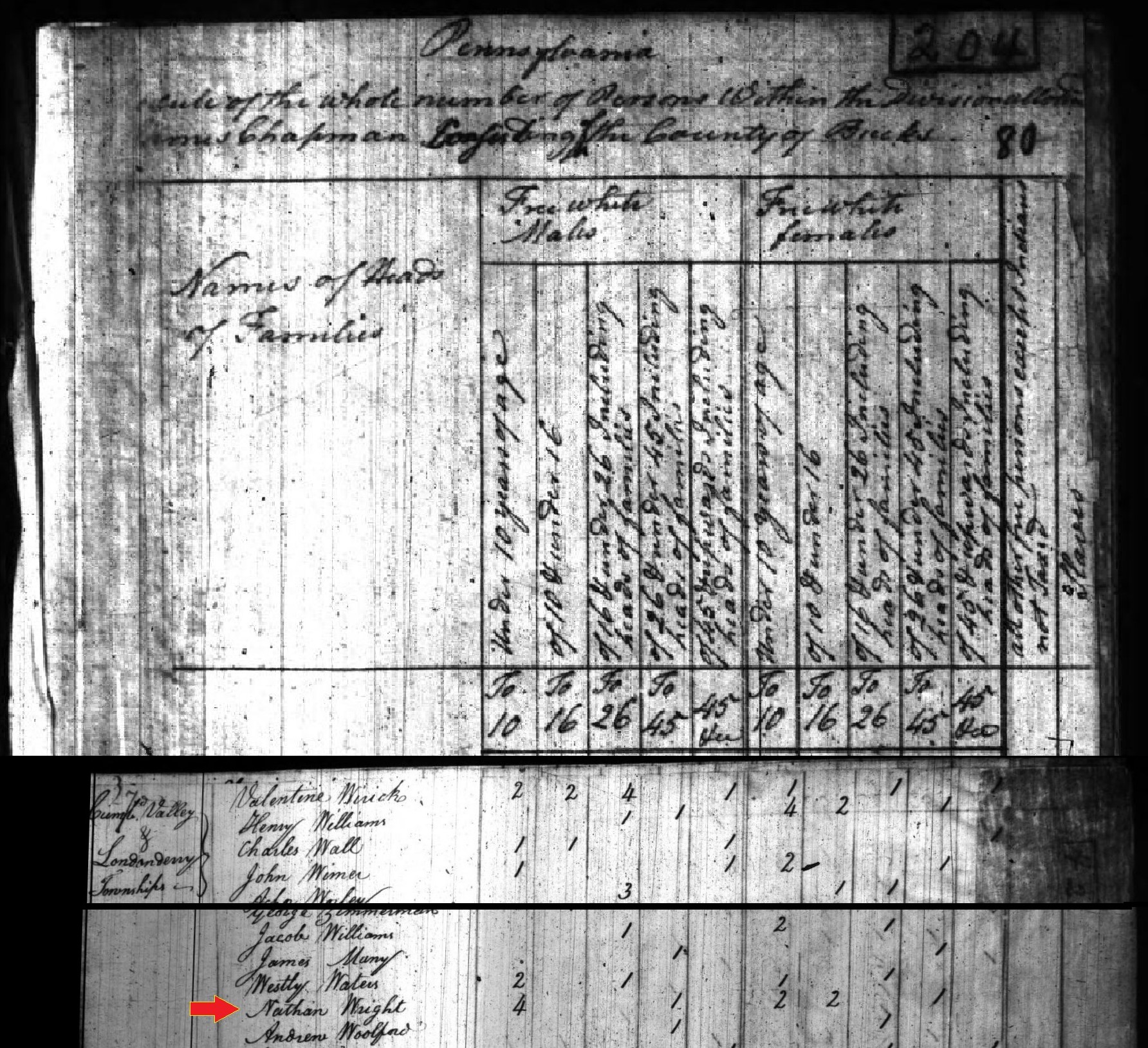
1800: In the following image the table header is from the 1800 census records of Bucks County, Pennsylvania and the tabular data is from the Cumberland Valley and Londonderry townships portion of the 1800 census records of Bedford County, Pennsylvania.
1807: The evidence that Moses Wright practiced gunsmithing while still living in Bedford County, Pennsylvania is presented by James B. Whisker on page 5 of the 2001 Whisker & Yantz book "Gunsmiths of Bedford, Fulton, Huntingdon, & Somerset Counties". The evidence takes the form of a full stock percussion conversion gun with Bedford County styling that is marked "PW" on the lock and marked "Moses Wright" on the upward facing flat of the octagonal barrel. (Click here to see a picture of the rifle.) Mr. Whisker interprets this combination of markings to mean that Moses Wright was an apprentice of the gunsmith Peter White. Mr. Whisker makes a strong case for this gunsmith apprenticeship in the November, 1982 issue of the "Muzzle Blasts" magazine and the September 1983 issue of the newsletter of the Association of Ohio Longrifle Collectors. In those articles, Mr. Whisker suggests the theory that the above-mentioned rifle may represent Moses Wright purchasing a lock from Peter White to put on a rifle Wright built.
Whisker's gunsmithing apprenticeship theory makes good sense because Moses Wright was born on October 5, 1792 and would have been about fourteen years old when, in the July 1806 to January 1807 timeframe, Peter White advertised in the "Bedford Gazette" for "...a smart active lad, from fourteen to sixteen years of age..." to serve as a gunsmithing apprentice.
1810: The 1884 book "History of Bedford, Somerset and Fulton Counties, Pennsylvania" indicates that Nathan Wright was commissioned as a Justice of the Peace for Cumberland Valley Township of Bedford County by the governor of Pennsylvania in 1810.
1810: I did not find Nathan Wright or Moses Wright listed in the very legible manuscript 1810 census records of Cumberland Valley Township or Londonderry Township of Bedford County, Pennsylvania.
1813: The 1894 book "A brief history of Harrison county, Ohio" states, "The act establishing the county of Harrison passed the legislature January 2d, 1813, to take effect January 1st, 1814. On January 12th the legislature amended the act making it take effect February 1st, 1813." The westernmost edge of Harrison County is about 15 miles east of the easternmost edge of Coshocton County. The easternmost edge of Harrison County is about 18-1/4-miles west of, but does not adjoin, Pennsylvania.
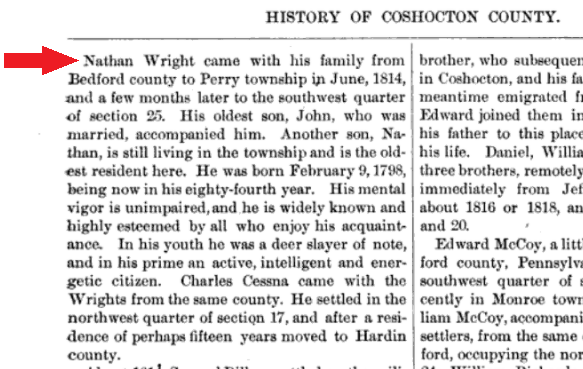
Circa 1814: The following excerpt from the 1881 book "History of Coshocton County Ohio" reports that Nathan and Hannah Wright moved west to Coshocton County, Ohio in 1814. An article titled "Wright Reunion" in the August 22, 1932 issue of the New Philadelphia newspaper "Daily Times" indicates that Nathan and Hannah (Worley) Wright came to Coshocton County, Ohio and settled in 1816.
1814-1816: In the 1814 to 1816 tax rolls of Cumberland Valley Township, Bedford County, Moses Wright is reportedly identified as a sickle smith. According to the 1982 "Muzzle Blasts" articleMoses Wright's name is stricken from the 1816 list.
1815: The 1952 book "Capt. James Hook of Greene County, Pennsylvania" indicates that Anna Larkin, a daughter of Thomas and Priscilla (Sullivan) Larkin, was born on August 24, 1792, married Moses Wright in Bedford County, Pennsylvania on April 4, 1815, and eventually lived near the town of Freeport, Ohio. Freeport is about 39-1/2-miles west of Pennsylvania.
Volume 2 of the 1914 book "A History of Preston County, West Virginia" includes the statement, "Thomas Larkin, father of William, was born March 26, 1763, married Priscilla Sullivan, Montgomery County, Md., January 15, 1782, and died February 23, 1834. Thomas, William and Lewessa Larkin and others of their generation are buried on the Moses Wright Homestead near Freeport, Ohio."
1815: Moses Wright's will indicates he had a son named Thomas. An article in the March 29, 1934 issue of the "Freeport Press" newspaper indicates that Moses Wright's eldest son Thomas was born in 1815. Thomas Wright is buried at the Woodland Cemetery in Greene County, Ohio. His tombstone states, "Thomas L. Wright. Born Dec. 25, 1815, died July 16, 1887."
1816: Whisker's February 1984 AOLRC article reports that Moses Wright stayed behind in Bedford County, Pennsylvania after his parents moved to Ohio in order to court a girl, and moved to Ohio in 1816.
1817: The March 29, 1934 issue of the "Freeport Press" indicates that Moses and Anna Wright left Pennsylvania in 1817 and moved to a farm that is located two miles to the west of Freeport, Ohio.
1818: The 1983 Whisker booklet indicates that Moses Wright was in Freeport (Harrison County, Ohio) after 1818.
1818: Moses Wright's will indicates he had a son named Nathan. Based on the 1850 census, Nathan was born circa 1819 in Ohio. A web page about Nathan Wright indicates that he was the son of Moses and Anna (Lakin) Wright, was born in Harrison County, Ohio on September 25, 1818, and died on January 19, 1900.
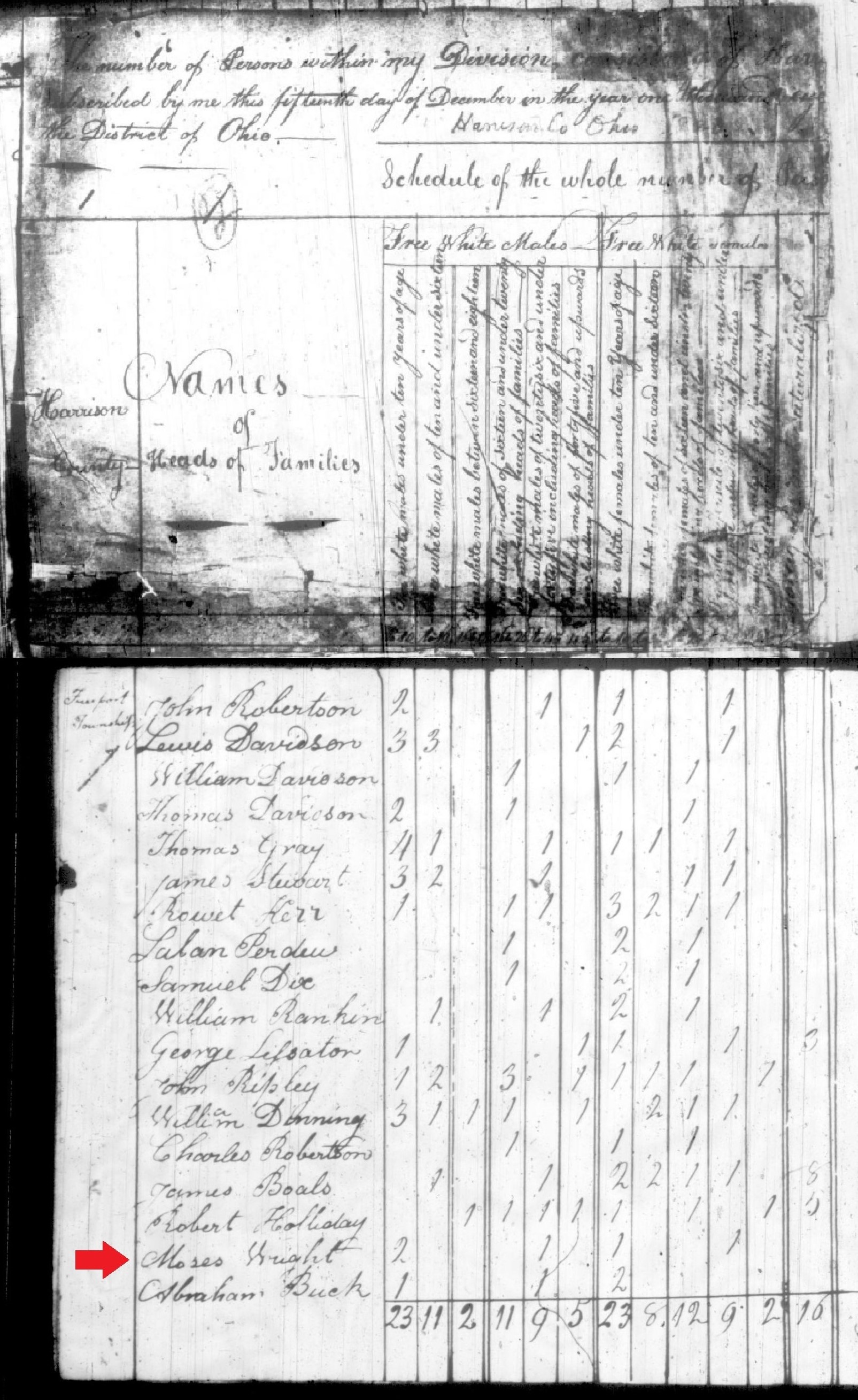
1820: The following image is a composite made from two different pages of the 1820 census records of Harrison County, Ohio. The bottom portion is from the Freeport Township portion of the census records, and the top portion is from the beginning of the county records.
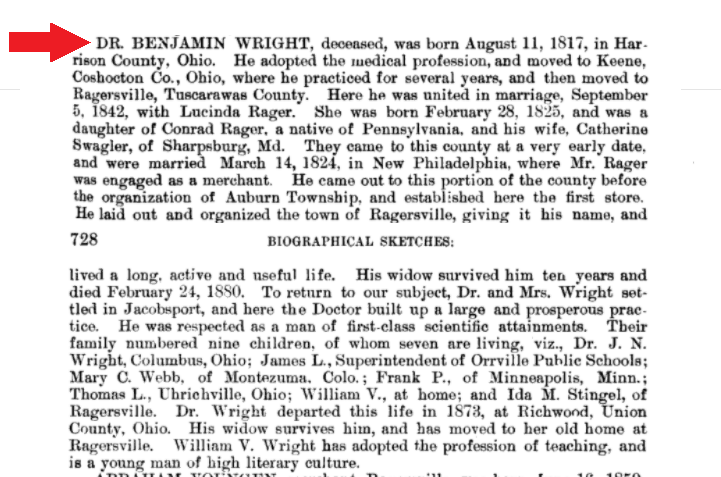
1820: Moses Wright's will indicates he had a son named Benjamin. The September 2003 AOLRC newsletter has an article by Barbara Wright Makee that indicates Moses Wright's gunsmith/physician son Benjamin Wright was born in Ohio on August 11, 1820 and died on March 20, 1874. The article has photos of Moses, Benjamin, and William Wright and their rifles, and a biography of Benjamin Wright that references the following material in the 1884 book "The History of Tuscarawas County Ohio":
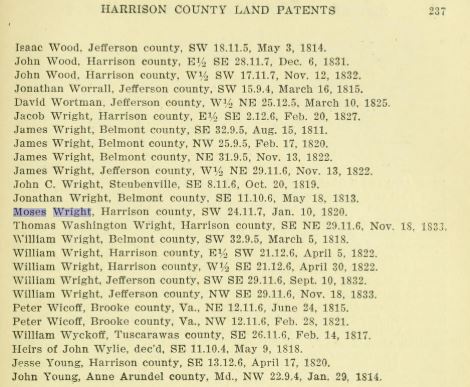
1820: The following list from the 1900 book "Historical Collections of Harrison County...." indicates that Moses Wright received a land patent in Harrison County, Ohio in 1820.
1820: James Whisker's article in the September 1983 issue of the newsletter of the Association of Ohio Longrifle Collectors indicates that Moses Wright is enumerated as a gunsmith in the census of 1820.
1822: Moses Wright's will indicates he had a son named William. The following death certificate indicates that Moses Wright's gunsmith son William Wright was born on February 10, 1822.
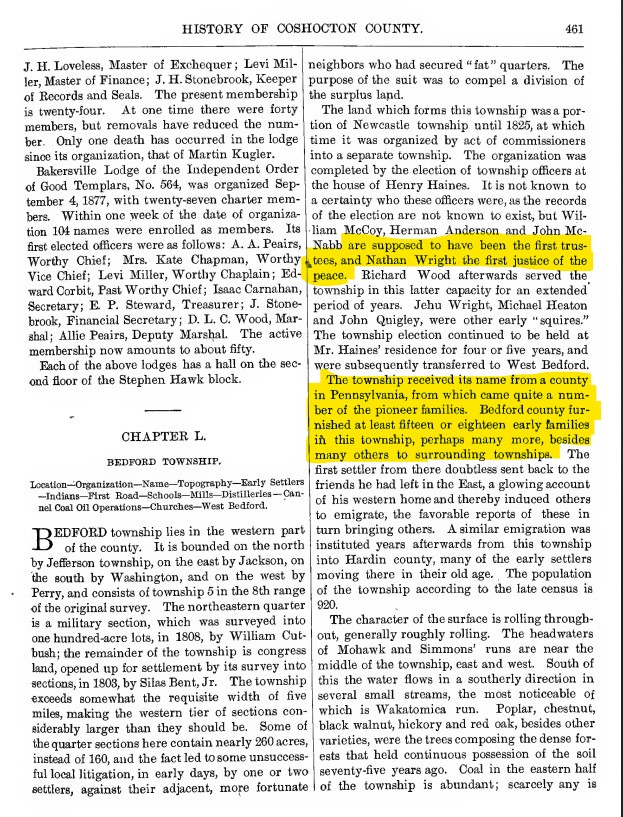
1825: Page 461 of the 1881 book "History of Coshocton County Ohio" indicates that although the election records were lost, Nathan Wright was supposed to have been the first Justice of the Peace when Bedford Township was formed in 1825. The page goes on to say, "The township received its name from a county in Pennsylvania, from which came quite a number of the pioneer families. Bedford County furnished at least fifteen or eighteen early families in this township, perhaps many more, besides many others to surrounding townships."
Circa 1826: Moses Wright's will indicates he had a daughter named Priscilla. Based on the 1850 census, Priscilla was born circa 1826 in Ohio.
Circa 1828: Moses Wright's will indicates he had a son named Moses. Based on the 1850 census, Moses was born circa 1828 in Ohio.
1829: Moses Wright's will indicates he had a son named Isaac. Based on the 1850 census, Isaac was born circa 1830 in Ohio. The following death certificate indicates that Moses Wright's son Isaac Wright was born on October 7, 1829.
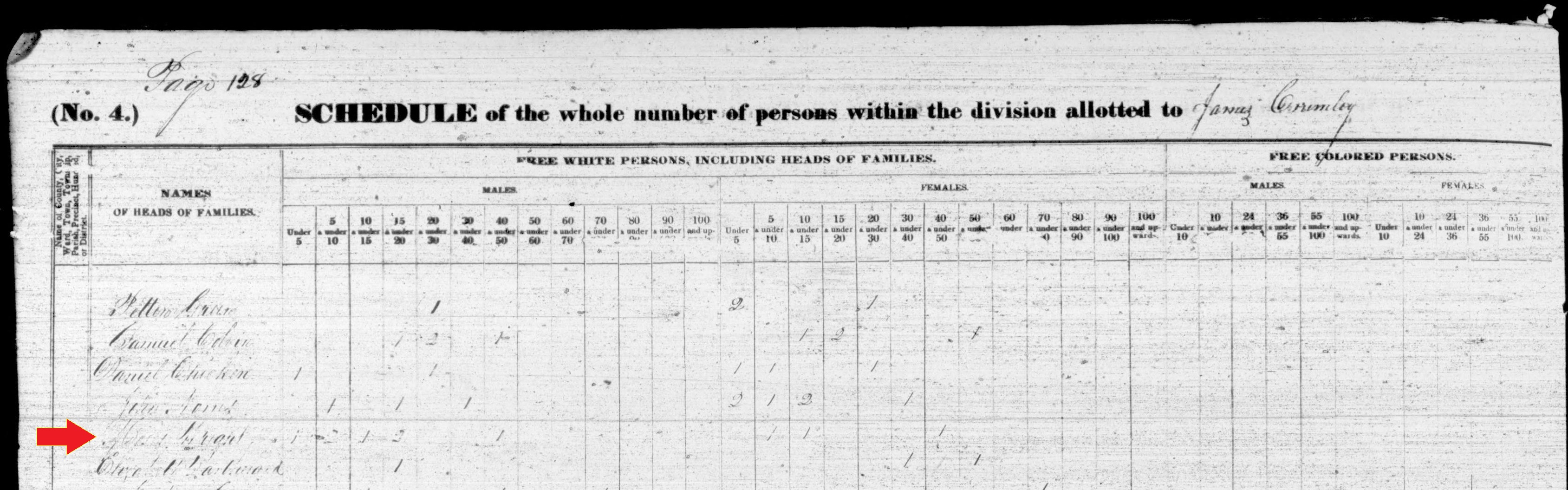
1830: The following excerpt is from the 1830 census records of Freeport Township, Harrison County, Ohio.
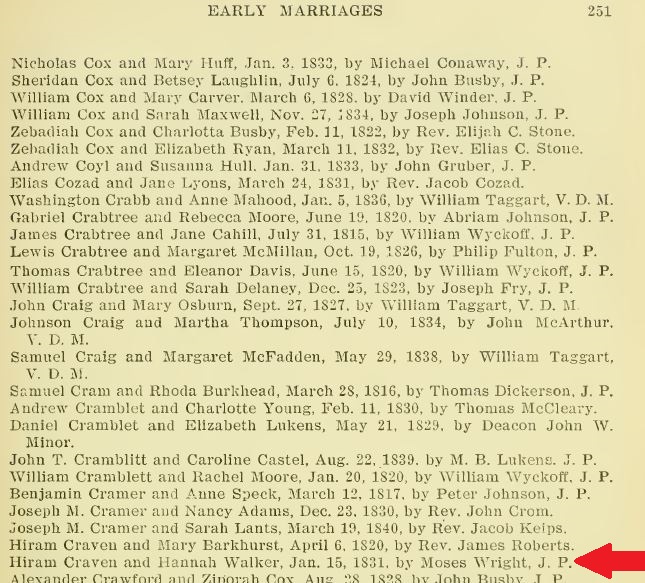
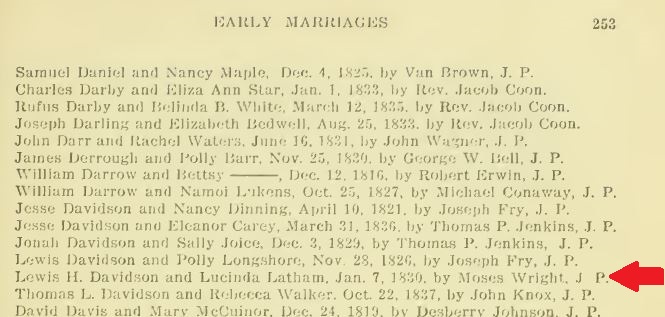
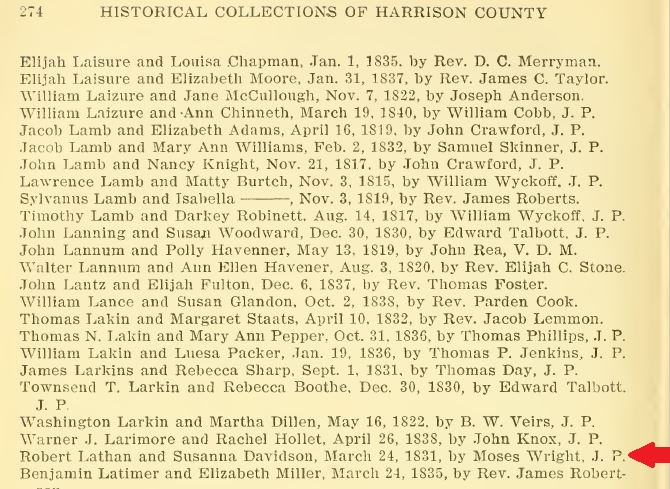
1830-1831: The following pages from the 1900 book "Historical Collections of Harrison County...." show that Moses Wright was a Justice of the Peace in Harrison County, Ohio and in that role performed weddings.
Circa 1832: The 1850 census suggests that Moses Wright had a daughter named Mary who was born circa 1832 in Ohio.
Circa 1835: Moses Wright's will indicates that he had a son named John. Based on the 1850 census, John was born circa 1835 in Ohio.
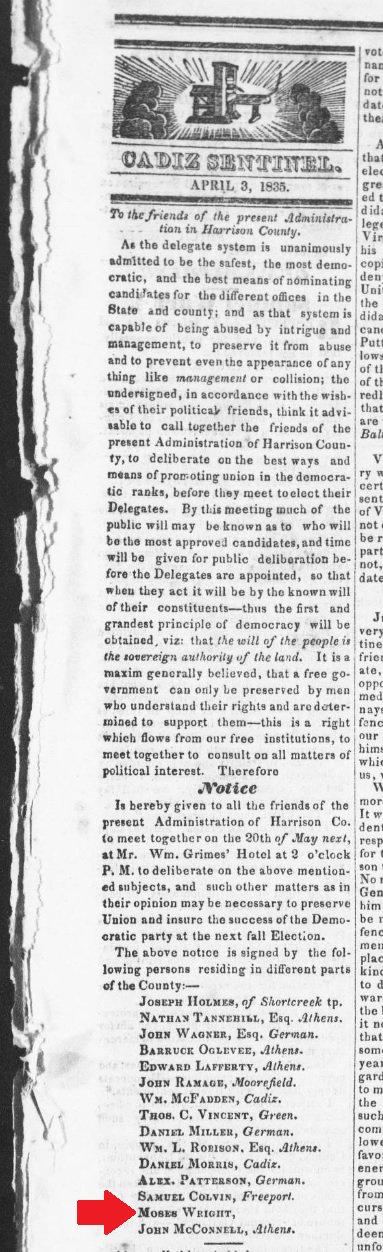
1835: The following political letter was published in the April 3, 1835 issue of the "Cadiz Sentinel" newspaper, and signed by Moses Wright.
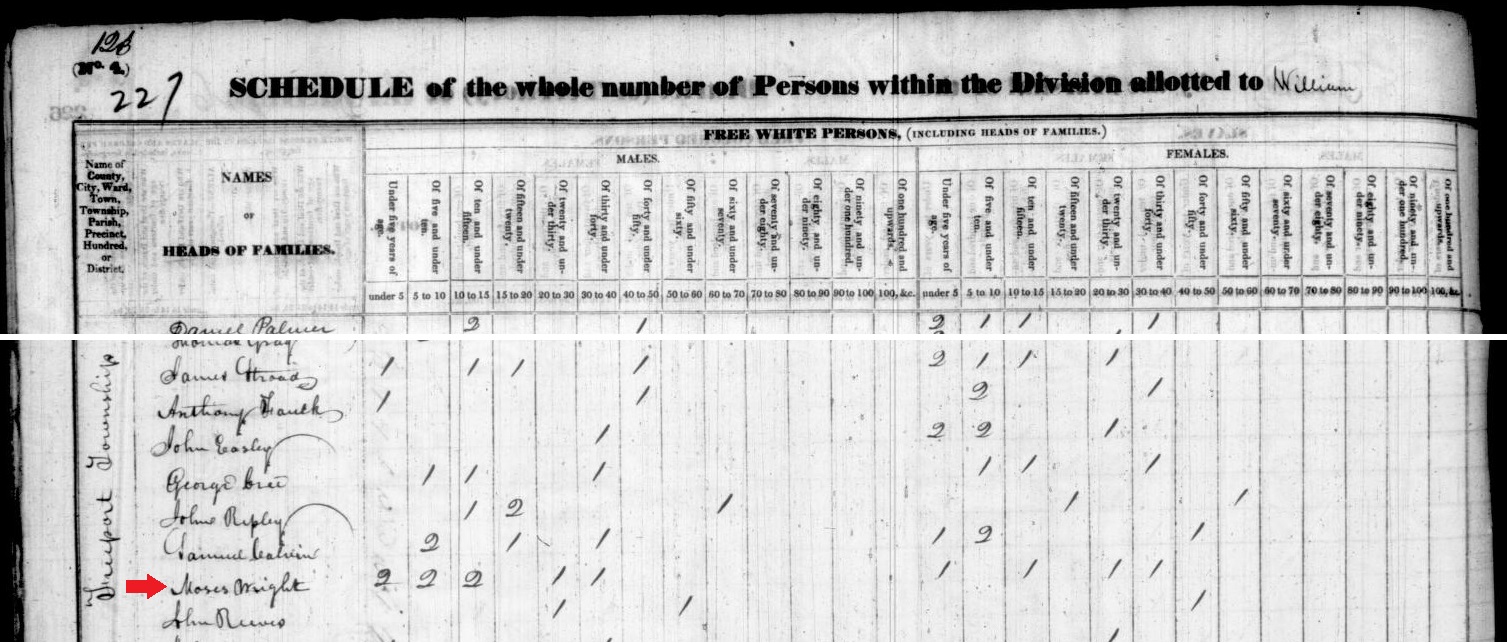
1840: The following listing for Moses Wright is from the 1840 census records of Freeport Township, Harrison County, Ohio.
1847: Whisker's February 1984 AOLRC article reports that Moses Wright's mother Hannah died April 5, 1847. This is harmoneous with the 1847 date on her tombstone that is mentioned above.
1848: An article by Warren Offenberger in the February 1984 newsletter of the AOLRC features photos of a full stock percussion rifle by Moses Wright. The 13/16-inch octagon barrel is 41-inches long and has a brass inlay with "Moses Wright 1848" engraved in script. The trigger guard and butt plate are brass and the engraved patchbox is silver with a Bedford-county style Q-shaped finial. The rifle has 15 inlays, and I believe they are all silver except for the barrel inlay.
1850: The 57-year-old Pennsylvania-born gunsmith Moses Wright is enumerated in the 1850 federal census of Freeport Township, Harrison County, Ohio. In his household were 57-year-old Pennsylvania-born Ann, 31-year-old Ohio-born schoolteacher Nathan, and five additional children. The household of William Wright is also included in the following composite image. William Wright is enumerated as a 28-year-old Ohio-born farmer. Also living in his household were 25-year-old Ohio-born wife Mary, and 2-year-old Ohio-born Anna.
1850: According to the 2017 Whisker book "Gunsmiths of Bedford County, Pennsylvania", in the 1850 federal census of Freeport Township, Benjamin Wright is enumerated as a 29-year-old Ohio-born gunsmith. In his household were 25-year-old Ohio-born wife Lucinda and three children the oldest being John W., and 20-year-old Ohio-born gunsmith John Martin.
1851: Whisker's February 1984 AOLRC article indicates that Moses Wright's father Nathan died June 15, 1851.
1852: The following item is from the September 1, 1852 issue of the "The Democratic sentinel and Harrison County farmer". It indicates that Moses Wright Sr. or Jr. was nominated for public office.
1853: Benjamin Wright is listed as a gunsmith in Peoli, Tuscarawas County, Ohio in the "Ohio State Business Directory for 1853-54" which was printed in 1853 by W. W. Reilly & Company.
1854: Moses Wright died in June of 1854 and is buried in the Wright-Shugart Cemetery, which is at or near Freeport, in Harrison County, Ohio. His wife Anna, who died in 1875, is also buried there. An article by Warren Offenberger in the November 2000 AOLRC newsletter indicates that the cemetery is on the former Moses Wright farm, above the house and near the orchard. That article has photos of the farm and cemetery and identifies the site of the Moses Wright gun shop. Only one tombstone remained in the cemetery in 2000.
1854: A published death notice for Moses Wright states, "--At his residence near Freeport, on the 1st inst., of consumption, Moses Wright, and old and respectable citizen of that township. His loss will be deeply felt by the community."
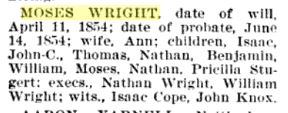
1854: The following synopsis of the will of Moses Wright is from the book "Historical Collections of Harrison County...." It provides the name of Moses' wife and children.
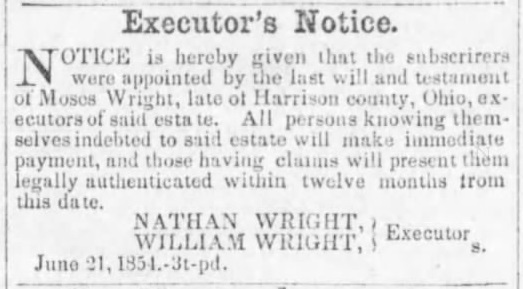
1854: The following notice, which relates to the estate of Moses Wright, is from the July 12, 1854 issue of the "Cadiz Sentinel" newspaper.
1854: The 2001 Whisker & Yantz book reports that Moses Wright's gunsmith sons Benjamin and William purchased gunsmithing related items at his August 17, 1854 estate auction. William purchased some gunsmithing tools for $5.00, iron for $1.32-1/2, and a grind stone for $1.00. Benjamin purchased a vice for $3.50. James B. Whisker's article about Moses Wright in the March, 2002 issue of the "Muzzle Blasts" magazine indicates that the estate auction records are in the Harrison County estate inventory book G.
1860: As shown by the following excerpts, William Wright was enumerated in the 1860 federal census of Freeport Township as a 38-year-old Ohio-born gunsmith between his widowed mother Ann Wright and his brother Isaac Wright. Also living in William Wright's household were his 36-year-old Ohio-born wife Mary and three children, the eldest being 12-year-old Anna.
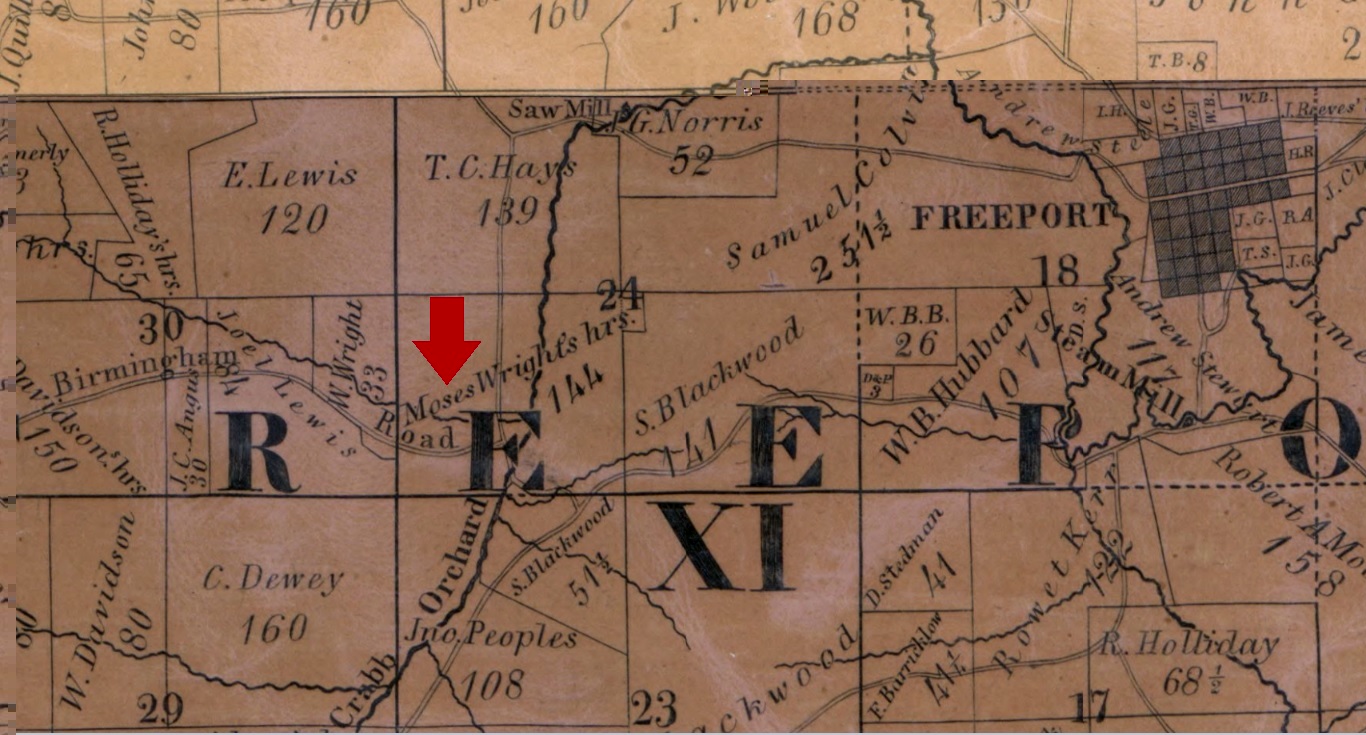
1862: The following excerpt from the 1862 Jarvis map of Harrison County, Ohio identifies the homestead of Moses Wright. From the creek and roads on the 1862 map, one can determine that the Moses Wright property is located at 40.203155, -81.298997.
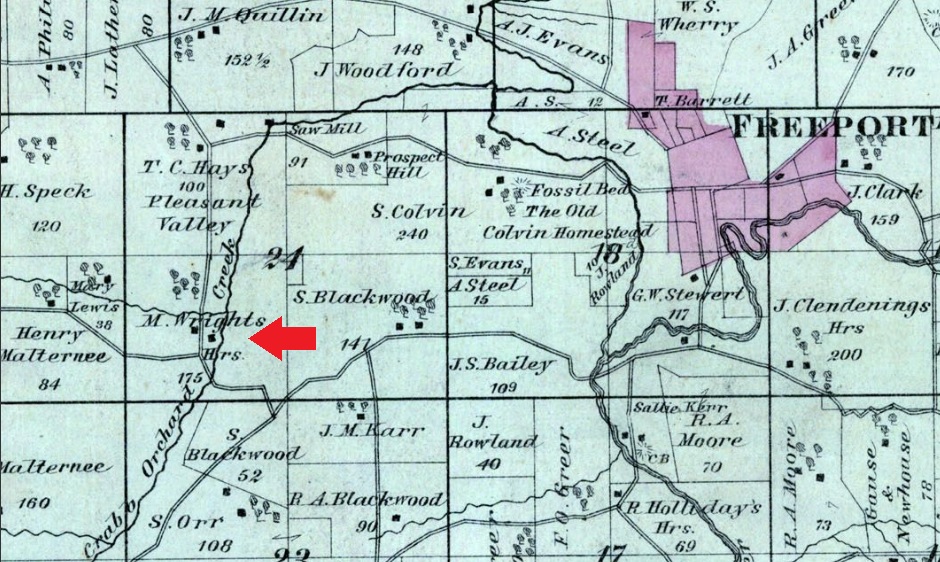
1875: The following excerpt from the Freeport Township map in the 1875 Harrison County atlas identifies building locations on the Moses Wright property.
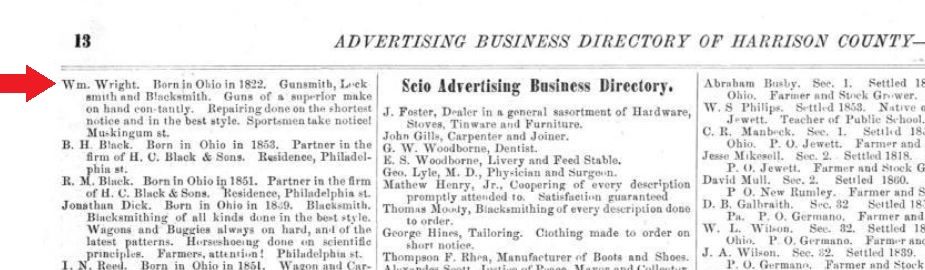
1875: The following excerpt from the Freeport section of the business directory in the 1875 Harrison County atlas identifies William Wright as a gunsmith, locksmith, and blacksmith on Muskingum Street.
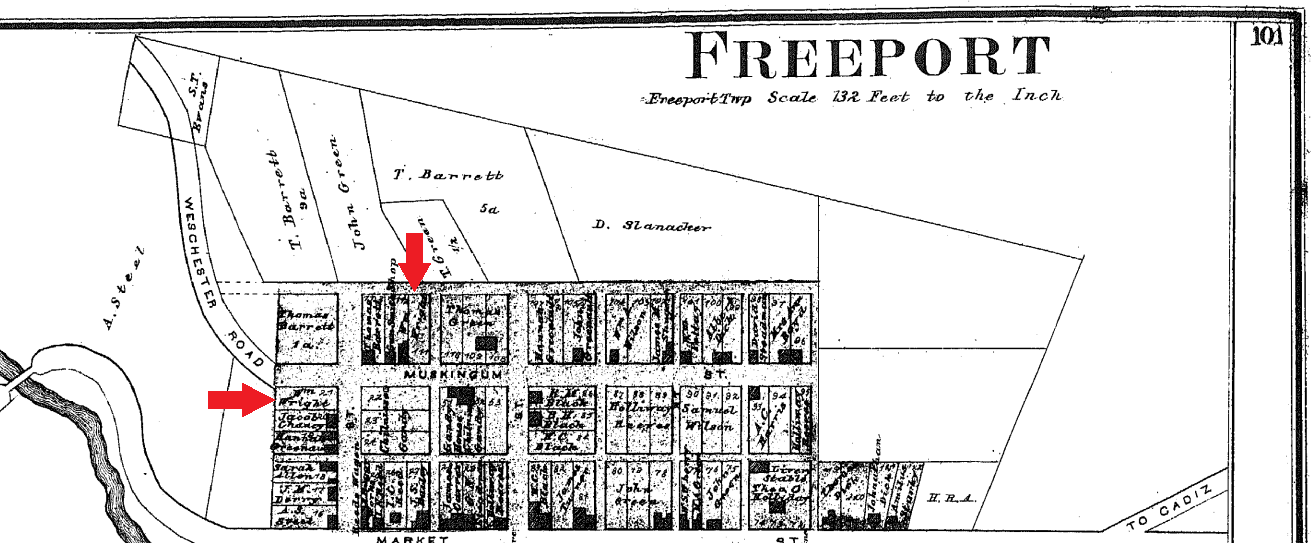
1875: The following excerpt from the Freeport section the 1875 Harrison County atlas shows the lots on Muskingum street that are labeled "Wm. Wright".
1878: According to the 2017 Whisker book, William Wright was identified as a Freeport gunsmith in the 1878 directory of Harrison County.
1880: In the 1880 federal census of Freeport, William Wright is enumerated as a 56-year-old Ohio-born gunsmith, living with his 54-year-old Ohio-born wife Mary and his 25-year-old gunsmith son Newton.
1934: The March 29, 1934 issue of the "Freeport Press" newspaper has an article by William D. Wright titled "My Grandfather's Gunshop" that describes Moses Wright as a rifle maker and cutler, and provides a brief description of Moses Wright's gun shop and house:
"My great-grandfather Nathan Wright was born in Virginia on Sept. 30, 1762. At the age of 14 he enlisted in the Revolution. After the war he married Hannah Worley of Colerain Township, Bedford County, Pa. My grandfather, Moses Wright, was the fourth child. Moses Wright was born Oct. 5th, 1792. Anna Lakin, his wife was born Aug. 24, 1792. Thomas, my father, their first child was born in 1815. In 1817 they moved from Pennsylvania to a large farm two miles west of Freeport, 0. Here, he erected a cabin, and a one story gunsmith shop and planted an orchard. The shop had a forge, hand bellows and anvil. He made work benches, tool racks and nearly all tools he used. He made gun barrels and did much repairing. Almost every rural householder had one of Mr. Wright's rifles and reaping sickles. When and after I knew him, he made no kind of guns except rifles. He made bullet molds in sizes marked 60, 80 and 100, meaning round bullets. 60 meant that many bullets to a pound of lead. Most of the rifles ran 80 and 100 per pound. Most game were squirrels and rabbits. Black squirrels were quite common. Hawks, owls and crows were common farm enemies.
As most cutlery was imported from Sheffield, England, it was expensive. Granddad made table knives and two tine forks, scissors, razors, spades shovels, mattocks, chopping axes, broad axes, froes for splitting blocks for shingles, and drawing knives for shaving them. He did not charge for pulling teeth. He did quick work with that. The joists in the gunshop were covered with gun stocks in the rough. Most were curly maple, beautiful when finished. The stock extended to the muzzle end of the barrel. A cavity in the breech was covered by a brass spring joint, in which was tallow and bullet patches. On the top of the barrel near the hind sight was engraved the name, M. Wright.
In testing a rifle he would give me a patch about one-half inch square, and a carpet tack to fasten into a block with a blackened face. He would stand in the shop door and shoot. I would mark the place with a small white stick. He would generally cut the patch. The gun was not considered true until he drove the tack into the block.
One day 3 men, nearly as dark as Indians, from exposure, came into the shop. Granddad shook hands with them and gave them a hearty welcome. They were trappers from the upper waters of the Missouri River, where they spent the winter in getting furs and trading with the Indians for their furs. In the early spring they would make a raft, pack their furs and other pelts, float down the Missouri to St. Louis, where they sold their furs for cash, silver and gold, bring their boat down to Cairo, then up the Ohio River to Wheeling, where they would debark and trudge to Freeport and get the rooms at the tavern. After breakfast, they came to the gun shop to have their guns repaired and order 5 or more new guns. They were profitable customers and paid cash. I would listen with open eye, mouth and ears, to their relating of killing bears, panthers and fights with other dangerous animals. They would leave in the fall to get back for another winter's hunt. They would get supplies that the Indians needed.
It was a delight for me to spend a week or 2 with Grandpa Wright. I felt free to ask questions, which he encouraged, and, when possible, would answer to the understanding of a child's intellect. I once saw a large red spot on the shop door. I asked what made it. Oh, he replied, one morning I shot a bear up the ravine and dragged it to the shop, took the door off its wooden hinges, laid it on the ground and skinned and dressed the bear on the door. That is bear blood.
On rainy or disagreeable days, the gun shop was a rendez-vous for young men of the community and the Wright boys, to joke, banter and witty exchange of repartee. But they were careful not to bother Moses Wright nor get in his way. He made a beautiful picture in his usual habit after eating his supper. He would take some bread out in front, under an apple tree and sit down. The little brown sparrows would swarm down and almost cover him, while he fed them crumbs. That was before the introduction of English sparrows and Norway rats. Only two of his sons, Benjamin and William, learned the gun making trade.
In 1828 Moses Wright built a buried log house on a steep hill side at the foot of his orchard. There were 3 stories facing south and 2 facing north. Whoever conceived such a structure does not deserve a monument nor medal for architecture."
1937: William D. Wright, author of the above March 29, 1934 article about Wright's gun shop, is buried in the Woodland Cemetery in Greene County, Ohio. His tombstone indicates he was born in 1842 and died in 1937. This means that William D. Wright would have been about 11 years old when his gun making grandfather Moses Wright died in 1854.
1949: I do not know if it is relevant, but an article titled "Railroad brought village of Cooperdale, Ohio into existence" in a 1949 issue of the Coshocton Tribune indicates that fine rifles that had been made near Cooperdale by the gunsmith William Wright were still owned by residents of the environs of Cooperdale. Cooperdale is 42 miles west of Freemont, Ohio.
Moses Wright work product:

1762-1786: An article by Jim Whisker in the February 1984 AOLRC newsletter reports that Moses Wright's father was Nathan Wright, who was born November 30, 1762 and married Hannah Worley from Cumberland Valley Township of Bedford County on August 29, 1786.










 Visit the Gunsmith Index for information on other early gunsmiths connected to western Pennsylvania, along with photos of the long rifles they created.