The photos on this page are reproduced here with the permission of Milestone Auctions of Willoughby, Ohio. They depict a plain, unsigned .40 caliber full stock 19th century muzzle loading rifle with percussion ignition that incorporates features of the Dormayer/Dunmyer "school" of gunsmithing (Somerset County, Pennsylvania). The practitioners of the "school" were:
This page is part of an online project that features the old-time guns and gunsmiths of Bedford and Somerset counties, Pennsylvania.
L. Dietle

Photos
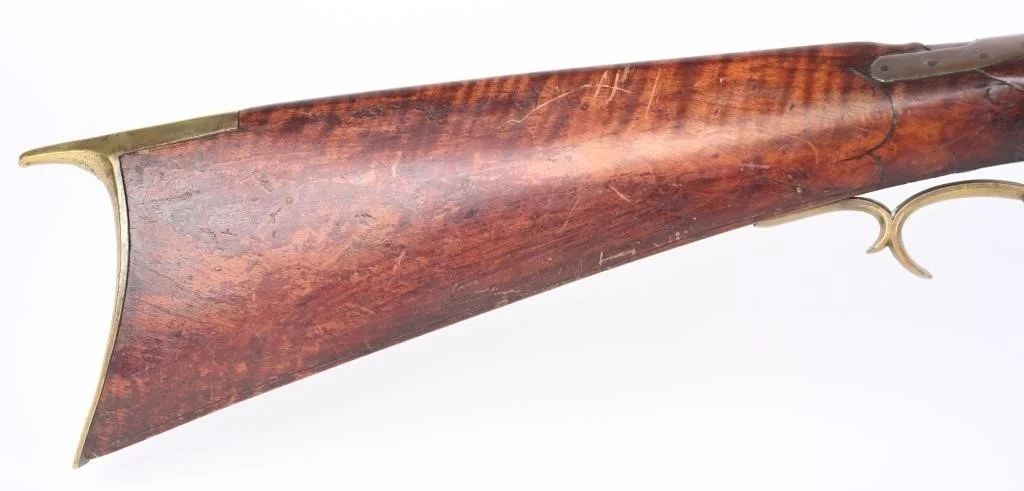
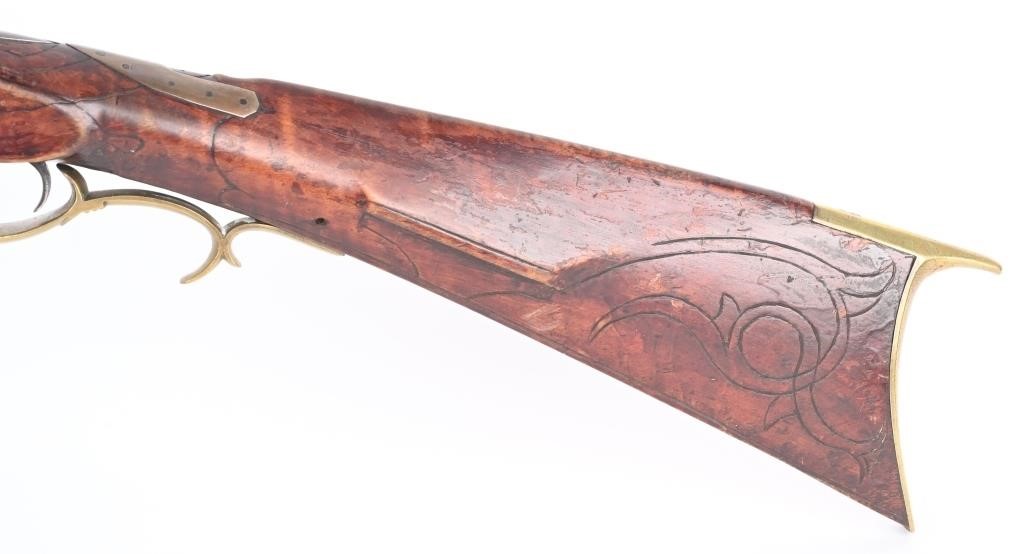
The next picture shows the right-hand side of the gracefully shaped buttstock, which does not appear to have a protective toe plate. The buttstock also lacks a patchbox or cap box. A thin incised line follows and is parallel to the lower edge of the buttstock. The belly of the buttstock is slightly curved. The low comb is characteristic for the region where the rifle was made. The picture also provides a good view of the cast brass buttplate, which has a pronounced crescent shape. The treatment of the rear of the scroll of the brass trigger guard is attractive, but departs from the usual trigger guard design found on rifles of the Dormayer/Dunmyer "school". I don't think that is a huge deal, because like the lock, the trigger guard may have been procured commercially.
I have seen the double arch carving at the transition between the stock and wrist on a "smooth rifle" by Joseph Mills, and on the Peter White rifle shown in Plate 128 of Calvin Hetrick's book "The Bedford County rifle and Its Makers". Robert Duppstadt, author of the booklet "The rifles made by Peter and Jonathan Dormayer..." told me that he knows of five rifles attributed to Peter Dormayer that have that type of wrist carving, and provided pictures of the wrists.
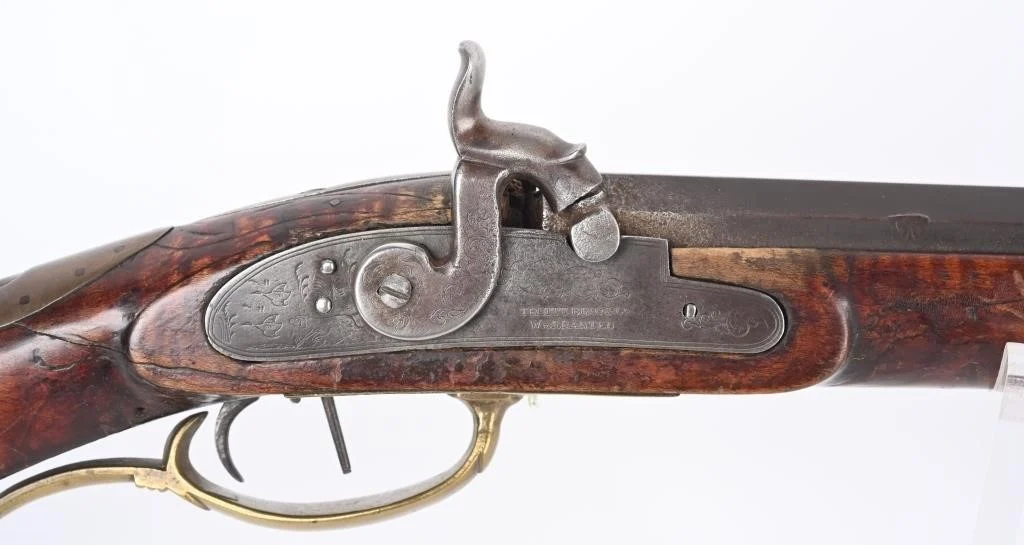
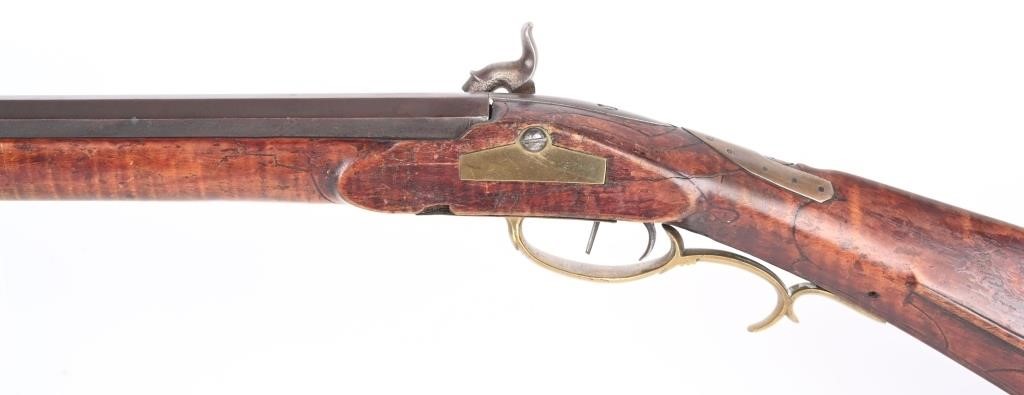
The next photograph shows the percussion lock and the mating panel of the wooden stock of this old gun. The percussion lock bears the name of the Truitt Brothers company and has a rounded tail. The second edition of Sellers' "American Gunsmiths" compendium indicates that the Truitt Brothers company appears in Philadelphia business directory listings from 1847 to 1861. The drum does not have a vent screw, but it does have a flat for mounting the percussion nipple. The photograph also provides a good view of the curved set trigger and the rod-like hair trigger. The wood just to the rearward of the barrel appears to be missing — eaten away as a result of the deteriorating effect of percussion cap flash. As is typical, the recessed nose of the percussion hammer telescopes over the nipple as a safety measure. One of the flats of the barrel is damaged, apparently from the use of a barrel wrench.
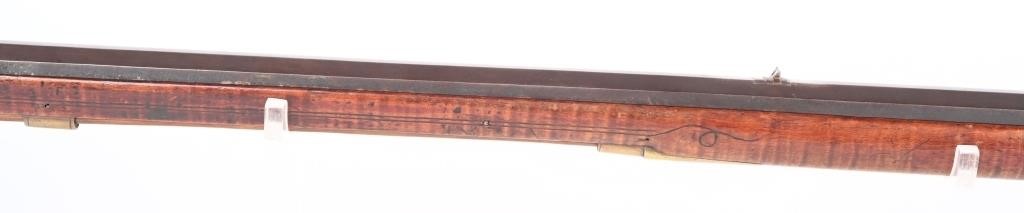
The following picture shows the forearm area in the vicinity of the ramrod entry pipe. The dovetailed rear sight is nearly aligned with the rear of entry pipe. The entry pipe has an unusually abrupt stepped configuration, and is similar to the one shown on the signed Jonathan Dormayer rifle shown here and to ones on the Charles Monroe Knupp rifles shown here and here. The transverse pin that retains the entry pipe to the stock, and one of the pins that retains the barrel to the stock, are visible in the picture. The incised carving on the forearm is similar to that on the signed Jonathan Dormayer rifle shown here.
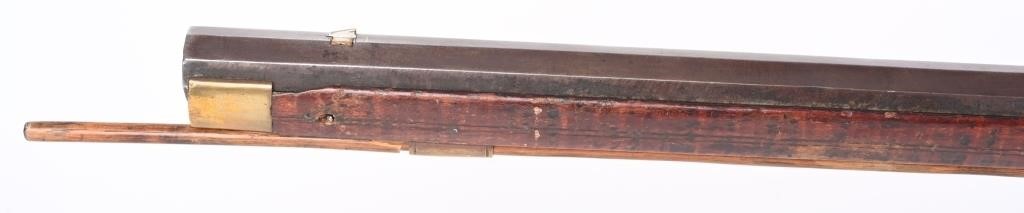
The following picture shows the right-hand side of the forestock portion of the rifle stock, including the brass nosecap, the forward ramrod thimble, the forward barrel retention pin, and the double incised line decoration. The nose cap is atypically short and the ramrod tip is not capped.
The next photograph shows the pointed tang of the breech plug and also shows a repair to the wrist. The horseshoe-shaped incised carving around the tang is characteristic of the Dormayer/Dunmyer school. The use of a pointed tang is common to the region.
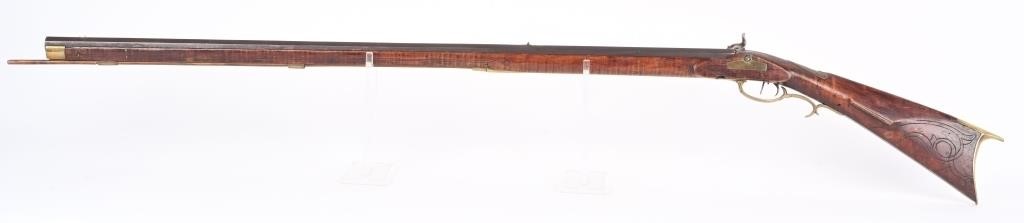
The next image provides a full-length view of the left-hand side of this handsome little antique black powder rifle.
The next picture shows the left-hand side of the carved buttstock, including the hole for the metal pin that retains the rear of the trigger guard to the rifle stock. The decorative incised carving under and rearward of the cheekpiece is characteristic of the Dormayer/Dunmyer "school" of gunsmithing. Compare to the incised carving on the signed Jonathan Dormayer muzzleloader shown here and the Charles Monroe Knupp muzzleloaders shown here and here.
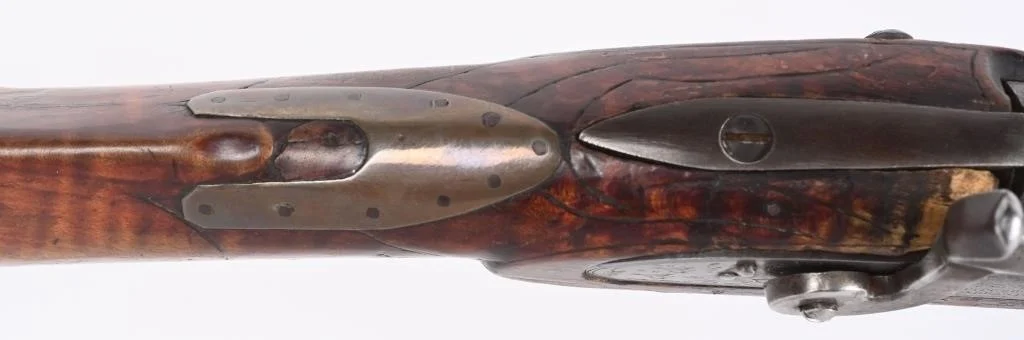
The next photograph features the lock bolt plate and the mating raised panel of the maple rifle stock. The incised line around the raised panel and the little incised beaver tail shape at the rear of the panel are typical to the Dormayer/Dunmyer school of gunsmithing. The tri-level effect at the upper front of the panel is also typical to the Dormayer/Dunmyer school of gunsmithing. This photo also reveals that the gun lock is retained by a single screw.
The next image shows the left-hand side of the forearm, the back sight, and the ramrod entry pipe. The incised carving is a repeat of what is found on the right-hand side of the firearm.
The next photograph shows the left-hand side of the forestock. The front sight appears to have a brass dovetailed base and a silver blade.
Go to the home page for additional regional history topics.

The first image below provides a full-length view of the right-hand side of the nicely proportioned rifle. This sparsely decorated yet visually pleasing percussion era rifle is stocked in curly maple and the unmarked full octagon barrel is 38.5-inches long. As you can see here, it has significant drop at the heel.



 Go to the Gunsmith Index for photos of other Somerset and Bedford County long rifles, biographies of the men who made them, and additional information on Pennsylvania long rifle history.
