Themes in the 2024 Memoir "In the Land of Used to Be"
Lannie Dietle's 365-page, photo-illustrated memoir is a warm, anecdote-driven Pennsylvania coming-of-age story set primarily in Mercer County's rolling hills and Somerset County's remote mountain farms along dirt roads miles from town. The book covers roughly 1953 to 1971, with a few stories from young adulthood thrown in for good measure. It's less a linear autobiography than a collection of vivid, lighthearted vignettes about "country kids" during the Baby Boomer era. The book functions as both personal memoir and informal social history, preserving a way of life that feels worlds away from today. Below are the major themes that emerge across its pages.
1. Nostalgia for Simpler, Pre-Digital Times
The title itself — "In the Land of Used to Be" — hints at the central emotional current: affectionate memories of mid-20th-century rural America before cell phones, video games, social media, and helicopter parenting. Dietle contrasts the unsupervised freedom of his boyhood with the more structured, screen-bound childhoods of later generations. The memoir invites older readers to smile at half-forgotten memories while giving younger readers a window into how their parents or grandparents actually spent their days. It's not idealized or preachy. The tone is matter-of-fact and often self-deprecating, but the overarching sense is that something valuable has been lost in the shift to digital life.
2. Freedom, Independence, and Self-Directed Play
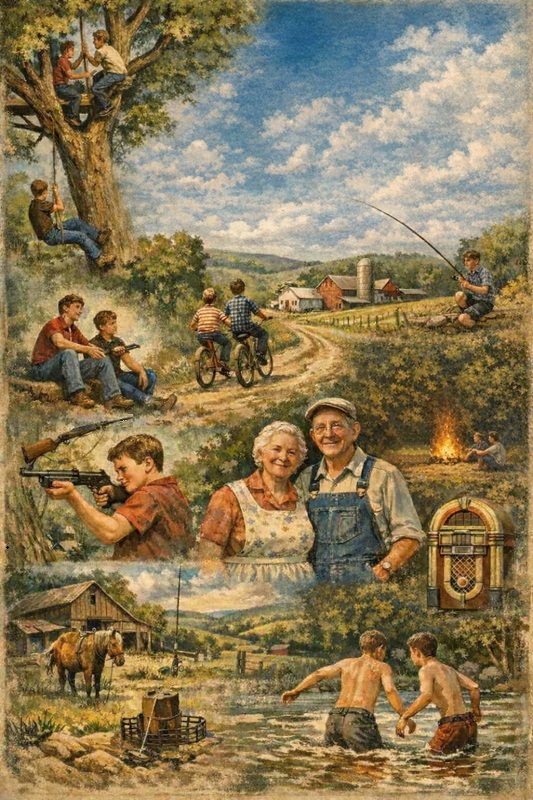
A defining feature is how much latitude rural kids had. With only school, church, and chores as formal obligations, children were largely "left to their own devices." The countryside became their playground. Early adventures happened on foot — exploring forests, fields, creeks, and dirt roads. Activities included fishing, wrestling, building tree houses, archery, BB-gun plinking, trapping, climbing (and chopping down) trees, swinging on grapevines, riding ponies, making slingshots, camping, and playing in barns. As they grew, bicycles extended their range, and eventually cars opened even wider horizons. This theme celebrates self-reliance and creativity born from freedom and open space.
3. Risk-Taking, Mistakes, and Maturation
Closely tied to freedom is the idea that real-world consequences were excellent (if sometimes painful) lessons. Dietle recounts boyhood jobs and escapades that would raise modern eyebrows: driving a 1944 Allis Chalmers tractor to bale hay at age six; receiving a hatchet and sheath knife that same year for woodland adventures; mail-ordering a rifle from the Sears catalog at twelve. Teenage years brought higher-stakes adventures — road racing, drifting, overnight field parties, moonshine, skinny-dipping, and memorable vehicular mishaps, with one vehicle ending up in a lake. The author reflects that these experiences, while not always representative of wise decision making, accelerated maturation. By age 21, many rural Boomers had already accumulated enough hard-earned lessons to function as independent adults. The memoir gently suggests this "learn-by-doing" model produced a certain resilience that today's more protected youth sometimes lack.
4. The Overlooked World of the Rural "Country Kids"
Dietle consciously shines a light on a subset of Baby Boomers whose stories are rarely told in pop-culture narratives focused on suburban or urban life. His tales feel universal to anyone raised in 1950s-70s farm country, yet they're deeply rooted in western Pennsylvania's specific landscape — hollows, hills, small-town rhythms, and family farms. The book captures the texture of everyday life among "regular folks": chores, part-time jobs, hunting, rock music, chasing girls, and community ties. It also nods to the broader societal changes happening in the background (the 1960s cultural shifts) while the kids remained somewhat insulated by geography and routine.
5. Family, Community, and the Pennsylvania Landscape
Underlying the adventures is a deep sense of place and kinship. Dietle's earliest memories are on his grandparents' isolated Somerset County farms. Later years center on Mercer County. Grandparents, neighbors, and local characters populate the stories. Work and play often blurred — helping on farms was both labor and bonding. The memoir quietly honors the tight-knit rural communities of mid-century Pennsylvania, where people knew one another and life moved at a slower, more grounded pace.
In short, "In the Land of Used to Be" is a heartfelt tribute to the joys, scrapes, and lessons of a rural Pennsylvania boyhood. Many of the memoir's stories later inspired Dietle's original Bluegrass and folk songs (e.g., "Ham on the Run," "Take Time When It Comes," "Kidd's Mills Road"), showing how these themes continue to fuel his creative work. The book is available in paperback via Amazon or the Mercer County Historical Society (all proceeds benefit the society), and it remains one of the most authentic portraits of that particular slice of American life you'll find. If you grew up in similar surroundings, it feels like flipping through a family photo album — only with richer storytelling.


