
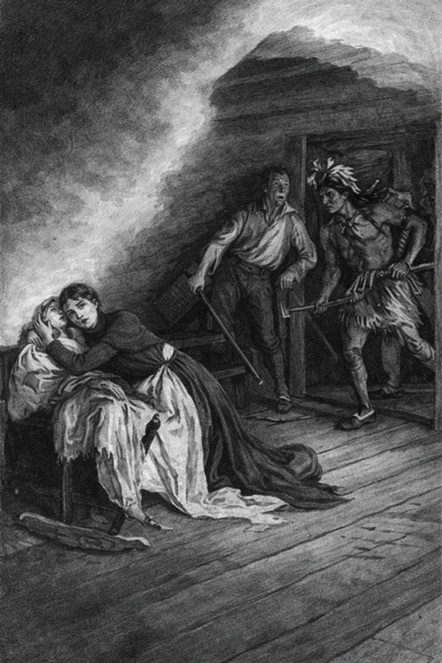
 The above picture is adapted from one in the 1897 book "The Pennsylvania Reader".
One thing that became clear while doing research for the “Fort Cumberland” book is that the general region surrounding Cumberland, Maryland was settled at the outset of the French and Indian War. Sadly, part of the proof is found in contemporaneous reports of settlers being exterminated, captured, and driven away by French-allied Indians. This article summarizes some of the mayhem.
An early reference to local raids is a report that over twenty families had been killed or kidnapped near Fort Cumberland in the October 1754 timeframe. The report also indicated that Washington was in pursuit of the war party. By this time, the Fort Necessity affair was about three months in the past, and Fort Cumberland was under construction.
The first of Braddock’s forces left Fort Cumberland and began moving toward Fort Duquesne on May 29, 1755, and the last departed the fort on June 10, 1755. Nurse Browne’s journal entry for June 19, 1755 reports that Fort Cumberland was crowded with local families, and the wives of soldiers, all seeking protection from Indian attack.
The Seamen’s journal entry for June 24, 1755 reports two families, numbering 14 or 15 individuals, being killed and scalped within three miles of Fort Cumberland. Two days later, he mentions two more families scalped within two miles of the fort, and the discovery of a young child still alive. The child was about seven years old, but had been scalped and had two holes through the skull, and died at the fort. This may be the June 23, 1755 attack on the Dawson and Williams families that Colonel Innes of Fort Cumberland described, where three individuals were killed, and eight were kidnapped. On June 30, 1755, John Harris wrote that since the June 23 attack, over twenty more individuals had been killed or captured near Fort Cumberland. A July 5, 1755 message from Horatio Sharpe reveals that the families that were killed in the second attack were on their way to Fort Cumberland seeking refuge—he reports 15 dead out of a party of 19, including the young child who had been scalped and left for dead. With the child’s demise, the total death toll was 16.
A July 4, 1755 Virginia newspaper article includes a report that several inhabitants were killed and wounded on Patterson’s Creek, within ten miles of Fort Cumberland. The article goes on to state that since the original report was received, five more families were attacked. A 1755 magazine article reports the loss of 14 families on Patterson’s Creek, and states that the brains of the children were dashed out on doorposts, and the parents were scalped.
On July 5, 1755 Nurse Browne reports several families scalped within ten miles of the fort, including a young boy who lived four days. This may be a reference to the same attack that was described in the June 26 Seaman’s journal entry. In the same July 5 journal entry, Browne again reports many families taking refuge at the fort.
On July 9, 1755—the same day Braddock was mortally wounded—Sharpe wrote a letter to Braddock indicating that 26 individuals had been killed or captured since Braddock left Fort Cumberland. Letters in the August and September timeframe describe settlers fleeing the area.
A September 25, 1755 letter describes an armed lad being temporarily captured very close to the Fort, then escaping with two arrow wounds. A newspaper article published a few days later indicates the boy was coming to the fort with a wagon. A September 27, 1755 article describes rescuing a hunter who was being chased by Indians within shouting distance of the fort.
An October 4, 1755 letter written by William Trent from what is now Williamsport, Maryland mentions settlers on Patterson’s Creek and around Fort Cumberland, and describes forty individuals killed or captured, including an entire family that were burned to death in a residence. He also reports on the capture of John Fraser’s wife near Fort Cumberland. In a postscript to the letter, he mentions the burial of 42 individuals near the mouth of Patterson’s Creek. A subsequent magazine article reports that the 42 individuals were seeking refuge in a blockhouse, and were found murdered and scalped. Trent closed his letter by stating that the lives and freedom of 100 individuals would have been saved if advice he gave had been followed, or if the assistance he requested had been granted.
On October 5, 1755, Thomas Cocks wrote that Thomas Cresap’s fortified house was under siege. On October 6, 1755, Sharpe wrote a letter describing the capture of three or four people within a few miles of Fort Cumberland. On October 6, Adam Stephan wrote a letter that mentions an escaped prisoner bringing two enemy scalps to Fort Cumberland.
An October 9, 1755 newspaper describes the Fraser incident, and reports that Benjamin Rogers, his wife, and seven children were killed or captured, along with Edmund Marle, another family of 12, and 15 other individuals. Benjamin Rogers was trying to make a go of a farm in Virginia, across from the Allegany Fairgrounds. The same article reports that people were cut off on Town Creek, and that Daniel Ashloff appears to be the only survivor of a small party that was fleeing that area.
On October 11, 1755, Washington reported that 71 individuals were killed or missing on the South Branch. Pennsylvania state records from October, 1755 describe a report from Fort Cumberland estimating that 100 individuals had been killed or captured in the environs of the fort, using the term “around the fort”. On the same day, Sharpe reported the same estimate in a letter, indicating that the people who were killed or captured lived near Fort Cumberland, and below the fort on both sides of the Potomac River. A French account of the October 1755 attacks near Fort Cumberland has also been found, as have French accounts of continuing depredations in 1756. One of these 1756 accounts—written by a French clergyman—describes routine rape, torture, murder, and cannibalism.
On October 25, 1755, while marching from Patterson’s Creek to Fort Cumberland, Charles Lewis observed many deserted homes, and describes one hastily buried settler who had been exhumed and eaten by wolves. On October 27, 1755, Washington ordered work parties to be sent to the abandoned plantations of settlers who had been killed or captured, to harvest corn.
On December 3, 1755, Captain Spotswood visited the farm of a family named Williams while on a foray from Fort Cumberland to harvest corn from abandoned farms, and found a man, woman, and child who had been killed and scalped. On December 6, 1755, Charles Lewis was on the same kind of foray out of Fort Cumberland, and describes three individuals at a fine plantation who were scalped and partially consumed by fire, and also describes their brains sticking to the stakes that were used to murder them. There was a mill on this farm, which indicates the presence of other settlers. A December 26, 1755 letter to George Washington describes using the corn from the farms of slaughtered settlers to sustain Fort Cumberland’s cattle.
These events are horrible to contemplate, but are an authentic part of the history of the area. As I did the research for the book, I also found various contemporaneous references to early local settlers that were not written in the context of the mayhem that occurred in the region. Such references relate to things like settlers selling food and liquor to soldiers at the fort, various farms being used to support Fort Cumberland (including farms west of Fort Cumberland), etc. Between the two types of references, I believe there is ample evidence proving that the general environs of Fort Cumberland were settled at the outbreak of the French and Indian War. The detailed evidence is presented verbatim in Volume 1 of the two-volume book set “Fort Cumberland”, which is available from Amazon. All proceeds benefit the Allegany County Historical Society.


Visit the "Fort Cumberland book" Facebook page!